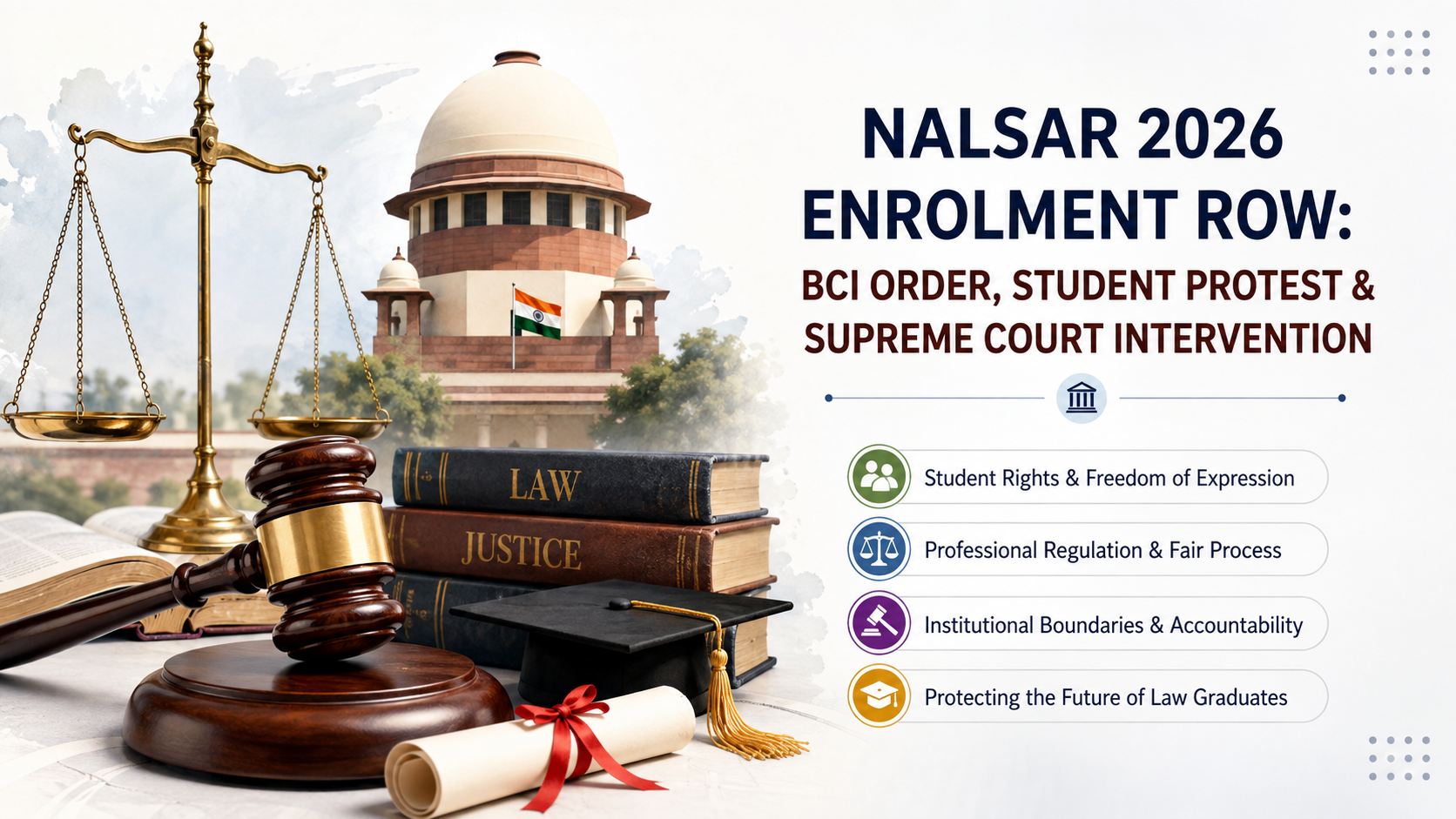
A controversial decision by the Bar Council of India (BCI) to halt the enrolment of NALSAR University of Law’s 2026 graduates triggered an immediate legal and institutional controversy. Within hours, the BCI reversed course, and the Supreme Court subsequently questioned the very basis of the action.
The episode has raised important questions about student dissent, freedom of expression, professional enrolment, regulatory power and institutional boundaries.
What initially appeared to be a dispute over a university convocation quickly developed into a much larger debate: Can an entire graduating batch of law students face professional consequences because of a protest or campaign involving some students?
Here is the complete story.
🔴 What Happened at NALSAR?
NALSAR University of Law in Hyderabad became the centre of controversy after a section of students reportedly objected to the proposed participation of Chief Justice of India Surya Kant as the chief guest at the university's 2026 convocation.
The students' campaign reportedly questioned or opposed the invitation.
The controversy then moved beyond the university campus.
On August 13, 2026, the Bar Council of India issued directions concerning the enrolment of NALSAR's 2026 graduating batch, initially directing State Bar Councils not to enrol graduates from that batch as advocates until further orders.
That decision immediately attracted criticism because enrolment with a State Bar Council is a critical step for a law graduate seeking to enter legal practice.
For a law graduate, completing a law degree is not necessarily the end of the professional qualification process.
A graduate who wants to practise as an advocate must satisfy the applicable enrolment requirements and become enrolled with a State Bar Council.
Therefore, stopping enrolment can have serious consequences.
It can potentially affect:
- 👩⚖️ The graduate's ability to begin legal practice
- 📜 Professional enrolment
- 💼 Early career opportunities
- 🏛️ Eligibility for certain legal positions and professional pathways
- ⏳ The timing of a graduate's entry into the profession
That is why the BCI's initial direction generated such a strong reaction.
The concern was not merely about a university event.
It potentially affected the professional future of an entire graduating batch.
This became the most controversial aspect of the episode.
The initial direction applied broadly to the 2026 graduating batch of NALSAR, rather than being limited to individually identified students who may have participated in the alleged campaign.
That immediately raised a basic principle of fairness:
Can students who were not involved in an alleged protest or campaign be made to suffer the same professional consequences as those who may have participated?The distinction is important.
There is a significant difference between:
Individual accountability
and
collective punishment.
If a particular student is alleged to have violated a rule, the conventional approach in a disciplinary system is to identify the person, establish the facts and provide an opportunity to respond.
Applying consequences to an entire graduating class creates a much broader problem.
The controversy escalated rapidly.
Following widespread criticism, the BCI modified and then withdrew the blanket restriction concerning the 2026 NALSAR graduates.
The Council subsequently stated that the majority of students were innocent and that no student should suffer without fault.
Later developments went further.
The BCI ultimately closed proceedings against the NALSAR 2026 batch after considering representations from senior advocates, members of the Bar, law students and members of the public.
According to reports, the BCI concluded that the 2026 batch had no role in any disturbance or movement and decided that no further action would be taken against the batch.
In simple terms:
- ❌ Initial position: enrolment of the 2026 batch was halted.
- 🔄 BCI subsequently withdrew/modified the restriction.
- ✅ Proceedings against the 2026 batch were later closed.
- ⚖️ The controversy nevertheless reached the Supreme Court.
The issue was brought before the Supreme Court.
A Bench headed by Chief Justice of India Surya Kant, along with Justice Joymalya Bagchi, took a critical view of the BCI's intervention.
The Court passed an interim order providing that no punitive action should be taken against NALSAR students or faculty at the instance of the BCI or any Bar Council in connection with the incidents referred to in the BCI's communications.
The Chief Justice also questioned why the BCI had intervened in what was essentially a matter involving students and the CJI.
Reports of the hearing quoted the CJI as saying that students have the right to peacefully protest and that the issue was a dialogue between him and the students.
This observation significantly changed the character of the controversy.
It was no longer simply:
"What did the NALSAR students do?"
It became:
"What are the limits of a professional regulator's power when dealing with student expression and protest?"
This is perhaps the most important constitutional and institutional question arising from the episode.
Students do not lose their rights merely because they are law students.
At the same time, the right to protest is not unlimited.
A student may express disagreement, organise a peaceful campaign or communicate an objection.
But conduct involving:
- violence,
- intimidation,
- destruction of property,
- threats,
- harassment,
- unlawful obstruction, or
- serious disciplinary violations
can potentially attract consequences under applicable law or institutional rules.
Therefore, the debate should not be reduced to:
"Students have a right to protest, so anything they do is acceptable."
That would be an oversimplification.
The more precise principle is:
Students can exercise legitimate rights of expression and peaceful protest, but unlawful conduct can still attract lawful consequences.The difficult question is how those consequences should be established and against whom.
The NALSAR episode illustrates why collective action against an entire professional batch can become problematic.
Consider two hypothetical situations.
Example 1: Individual responsibility
Suppose 10 students are established to have violated a specific university rule.
A disciplinary authority investigates those students individually and determines responsibility.
That is fundamentally different from preventing every student in the graduating class from entering the profession.
Example 2: Batch-wide consequences
Imagine a graduating class of 100 students.
If 10 students participate in a controversial activity while 90 have no involvement, preventing all 100 from enrolling creates consequences for students who may have done nothing wrong.
This is precisely why the BCI's later conclusion that the 2026 batch had no role in any disturbance became significant.
This controversy is not only about one university.
It raises questions that could matter to law students across India.
1️⃣ Can professional regulators intervene in student disputes?
The BCI is a powerful regulatory institution within the legal profession.
But professional regulation and university administration are not identical functions.
The Supreme Court's criticism has brought renewed attention to the boundaries between:
University administration → Student discipline → Professional regulation → Judicial oversight
Each operates within a different institutional framework.
2️⃣ Can professional consequences follow student activism?
This is another important issue.
If lawful student expression can automatically result in professional consequences, students may become hesitant to express legitimate disagreement.
That could have a chilling effect on academic debate.
Law schools, in particular, are expected to encourage students to engage critically with institutions, laws and public policy.
NALSAR itself describes its educational approach as encouraging students to think critically, challenge convention and uphold integrity.
That makes the balance between dissent and institutional discipline especially important in legal education.
3️⃣ Does disagreement with a constitutional authority amount to professional misconduct?
This question requires caution.
Disagreeing with a public authority is not automatically equivalent to professional misconduct.
The specific conduct matters.
Was the expression peaceful?
Was there intimidation?
Was there disruption?
Was there a violation of a valid rule?
Was a particular student actually involved?
These questions require evidence rather than assumptions.
One of the strongest lessons from the controversy is the importance of individualised fact-finding.
Before imposing a serious professional consequence, an authority should ideally establish:
- Who was involved?
- What exactly happened?
- What rule was allegedly violated?
- What evidence exists?
- Was the conduct unlawful or merely unpopular?
- Was the concerned person given an opportunity to respond?
- Is the proposed punishment proportionate to the conduct?
These questions are especially important when the consequence affects someone's professional career.
A law graduate should not have their future determined merely by association with a controversial event.
The NALSAR controversy also highlights the importance of maintaining appropriate institutional boundaries.
A university is responsible for education and campus administration.
A Bar Council regulates the legal profession.
Courts adjudicate disputes and interpret law.
These institutions inevitably interact, but their functions are not interchangeable.
When one institution enters an area traditionally handled by another, questions about authority and jurisdiction naturally arise.
That appears to be one of the concerns reflected in the Supreme Court's sharp questioning of the BCI's intervention.
As of August 14, 2026, the situation has moved considerably from the original BCI directive.
Current developments include:
- ✅ The initial blanket restriction on enrolment was withdrawn/modified.
- ✅ The BCI subsequently closed proceedings against the NALSAR 2026 batch after finding no basis to proceed against the batch.
- ⚖️ The Supreme Court criticised the BCI's action.
- ⚖️ The Supreme Court directed that no punitive action be taken against NALSAR students or faculty at the instance of the BCI or Bar Councils in relation to the incidents referred to in the BCI communications.
- 🗣️ The CJI emphasised that students have the right to peacefully express their views and protest.
So, the headline "NALSAR graduates cannot become advocates" is no longer an accurate description of the present position.
The more accurate description is that the BCI's initial attempt to halt the batch's enrolment was reversed, proceedings against the 2026 batch were subsequently closed, and the Supreme Court strongly questioned the original intervention.
There are several practical lessons here.
🎓 1. Know your rights — but also know your responsibilities
Freedom of expression is important.
But responsible advocacy requires understanding the boundaries of lawful conduct.
📜 2. Document everything
When participating in a campus dispute, students should preserve:
- Official communications
- Notices
- Emails
- Meeting records
- Statements
- Written representations
- Relevant institutional rules
Documentation becomes extremely important if a dispute later reaches a disciplinary or judicial forum.
⚖️ 3. Collective action should not erase individual responsibility
If students participate in a movement, the distinction between participants and non-participants should remain clear.
🧠 4. Law students should understand institutional power
A law degree is not just about memorising statutes.
It is also about understanding:
- Constitutional rights
- Administrative power
- Natural justice
- Institutional autonomy
- Professional regulation
- Judicial review
- Proportionality
The NALSAR episode is practically illustrating all of these concepts.
The most productive way to look at this controversy is not to blindly support either side.
There are legitimate questions on both sides.
Students have legitimate interests:
- The ability to express disagreement
- The ability to peacefully protest
- Protection from collective punishment
- Fair professional opportunities
- Individualised disciplinary proceedings
Institutions also have legitimate interests:
- Maintaining discipline
- Protecting institutional decorum
- Preventing unlawful disruption
- Ensuring respectful academic environments
- Addressing genuine misconduct
The challenge is finding the constitutional and legal balance between these interests.
And that balance cannot be achieved by assuming that every protest is legitimate or that every protest is misconduct.
Facts matter.
Evidence matters.
Procedure matters.
Proportionality matters.
The NALSAR 2026 enrolment controversy may ultimately be remembered as more than a dispute surrounding a convocation invitation.
It has become a case study in the relationship between:
Student rights + Institutional discipline + Professional regulation + Constitutional freedoms.
The most important lesson is simple:
A disagreement should not automatically become a professional punishment.At the same time, legitimate institutional discipline cannot simply be dismissed as retaliation.
The real test is whether authorities identify the actual conduct, establish responsibility through a fair process and impose a proportionate consequence.
For law students, that is perhaps the most valuable lesson of all.
The rule of law is not tested when everyone agrees. It is tested when institutions, students and authorities disagree.
📌 Key Points at a Glance
- 🔴 BCI initially directed State Bar Councils not to enrol NALSAR's 2026 graduates.
- 🧑🎓 The action followed controversy surrounding student opposition to CJI Surya Kant's proposed participation in NALSAR's convocation.
- 🔄 The BCI subsequently withdrew/modified its blanket restriction.
- ⚖️ The Supreme Court criticised the BCI's intervention.
- 🛑 The Supreme Court directed that no punitive action be taken against NALSAR students or faculty at the instance of the BCI or Bar Councils in relation to the cited incidents.
- ✅ BCI later closed proceedings against the 2026 batch after finding no basis to proceed against the batch.
- 🗣️ The episode has triggered a wider debate about student protest, freedom of expression, professional regulation and institutional boundaries.
📚 Sources & Further Reading
- LiveLaw — Supreme Court questions BCI action against NALSAR students and recognises students' right to protest. Read the LiveLaw report
- The Indian Express — Latest developments concerning BCI proceedings against NALSAR graduates. Read the Indian Express report
- LawBeat — BCI closes proceedings against NALSAR 2026 batch after finding no role in any disturbance. Read the LawBeat report
- The Federal — BCI reverses its enrolment decision while addressing the NALSAR controversy. Read The Federal report
- NALSAR University of Law — Official University website and academic information. Visit NALSAR University of Law
⚠️ Editorial Note
This article is intended for legal awareness and community discussion. It summarises publicly reported developments and should not be treated as legal advice. The matter has developed rapidly, and readers should refer to official court orders, BCI communications and authoritative sources for subsequent developments.