Rights of Advocates in India: Key Legal Rights Every Lawyer Should Know
Introduction
Advocates play a crucial role in the administration of justice. They act as officers of the court, protect the rights of citizens, and ensure fair legal representation. To perform these responsibilities effectively, advocates are granted certain legal and professional rights under various statutes and the Constitution of India.
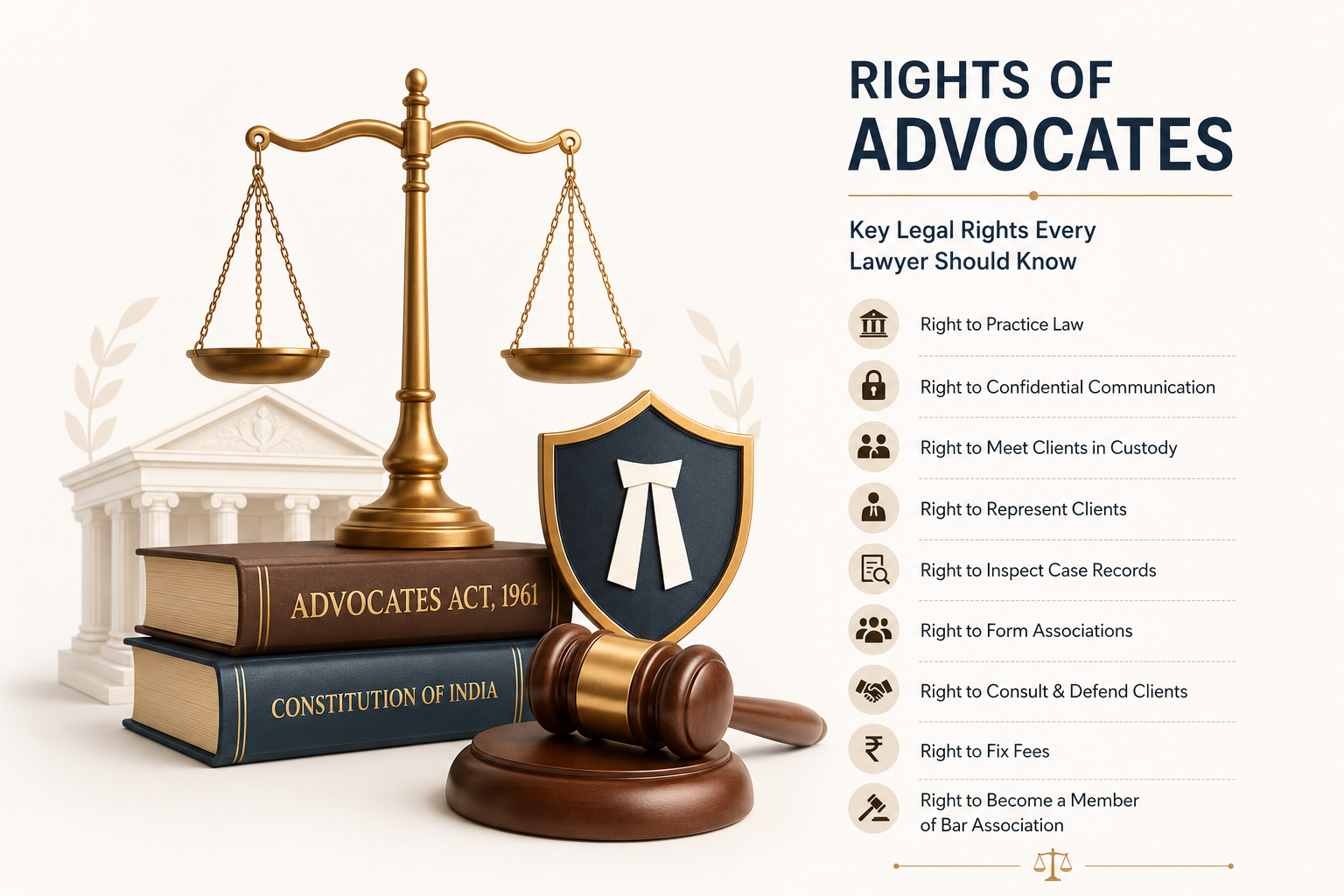
Understanding these rights is essential not only for advocates but also for law students and individuals interacting with the legal system. Here are nine important rights every advocate in India should know:
1. Right to Practice Law
Under Section 30 of the Advocates Act, 1961, every advocate whose name is entered in the State roll has the right to practice throughout India. This includes the right to appear before:
- Any court or tribunal in India;
- Legal forums and quasi-judicial bodies;
- Arbitration proceedings.
This right upholds the principle of fair representation as established in the landmark case Vishaka v. State of Rajasthan (1997), which emphasizes the necessity of legal representation in ensuring justice.
2. Right to Confidential Communication with Clients
The relationship between an advocate and client is built on trust and confidentiality. Sections 132 and 134 of the Bharatiya Sakshya Adhiniyam, 2023 protect professional communications between advocates and clients from disclosure, subject to certain legal exceptions. This right ensures that clients can communicate openly with their legal representatives, thereby maintaining the integrity of the attorney-client privilege.
In R. v. R. (1986), the importance of this privilege was underscored, establishing that without confidentiality, the advocate-client relationship would be compromised.
3. Right to Meet Clients in Custody
An advocate has the right to meet and communicate with clients who are in custody. This right flows from Article 22(1) of the Constitution of India, which guarantees every arrested person the right to consult and be defended by a legal practitioner of their choice. This protection is fundamental to ensuring fair legal representation, as highlighted in K.H. Kharak Singh v. State of U.P. (1964), where the Supreme Court recognized the essential nature of legal counsel during detention.
4. Right to Represent Clients
One of the most essential rights of an advocate is the right to represent clients before courts and legal forums. This includes:
- Presenting evidence and arguments;
- Cross-examining witnesses;
- Filing pleadings and applications.
Representation forms the core function of advocacy and is critical for upholding justice, as established in G. P. Singh v. State of M.P. (2002), which emphasized the role of advocates in the judicial process.
5. Right to Inspect Case Records and Documents
Advocates have the right to inspect case-related records and obtain relevant legal documents, which may include:
- Case files;
- Exhibits presented in court;
- Judgments and orders.
Access to such documents is necessary for preparing an effective legal strategy. The importance of this right is reflected in Central Bureau of Investigation v. Anupam J. Kulkarni (1992), which recognized that advocates must have access to information to defend their clients adequately.
6. Right to Form Associations
Under Article 19(1)(c) of the Constitution of India, advocates have the right to form associations. This includes:
- Creating bar associations;
- Participating in professional bodies;
- Engaging in collective bargaining.
These associations protect professional interests and support collective representation, fostering a strong legal community and promoting advocacy standards.
7. Right to Consult and Defend Clients
Advocates play a critical role in protecting legal rights. Article 22(1) strengthens this by ensuring every arrested person can consult and be defended by a legal practitioner of their choice. This right reinforces the importance of legal representation in safeguarding justice, as demonstrated in Maneka Gandhi v. Union of India (1978), which expanded the interpretation of personal liberty and legal representation.
8. Right to Fix Professional Fees
An advocate has the right to charge reasonable fees for professional services. Fee arrangements may depend on factors such as:
- The complexity of the case;
- The time required;
- The advocate's experience and expertise.
However, fees must remain ethical and in accordance with professional standards, ensuring that advocates do not exploit their clients. The Bar Council of India has issued guidelines to regulate fee structures, promoting fairness and transparency.
9. Right to Become a Member of Bar Association
Advocates are entitled to enroll under Section 24 of the Advocates Act, 1961, and become members of bar associations subject to applicable rules. Membership in bar associations provides:
- A platform for professional development;
- Networking opportunities;
- Access to resources and support systems.
It also strengthens the advocate’s connection with the legal community and enhances their professional standing.
Why These Rights Matter
The rights of advocates are not personal privileges alone. They exist to ensure:
- Upholding the rule of law;
- Protecting clients' rights;
- Facilitating fair trials and justice.
Without these protections, advocates cannot effectively discharge their duties within the justice system, leading to potential miscarriages of justice and erosion of public trust in legal institutions.
Conclusion
Advocates form the backbone of the legal system. Their rights are essential for maintaining the rule of law and ensuring justice is accessible to all. From the right to practice and represent clients to confidentiality and access to records, each right plays a critical role in empowering advocates to perform their professional duties effectively. Understanding these rights strengthens both legal awareness and professional responsibility within the legal ecosystem.
#DefendInk #AdvocatesRights #LegalAwareness #IndianLaw #LegalKnowledge