Entering the legal profession is a significant milestone, but many newly enrolled advocates are often confused about when they can begin practicing and whether clearing the All India Bar Examination (AIBE) is mandatory before appearing in court.
To address this confusion, the Bar Council of India (BCI) has clarified the rules regarding the two-year provisional practice period. Here's everything you need to know.
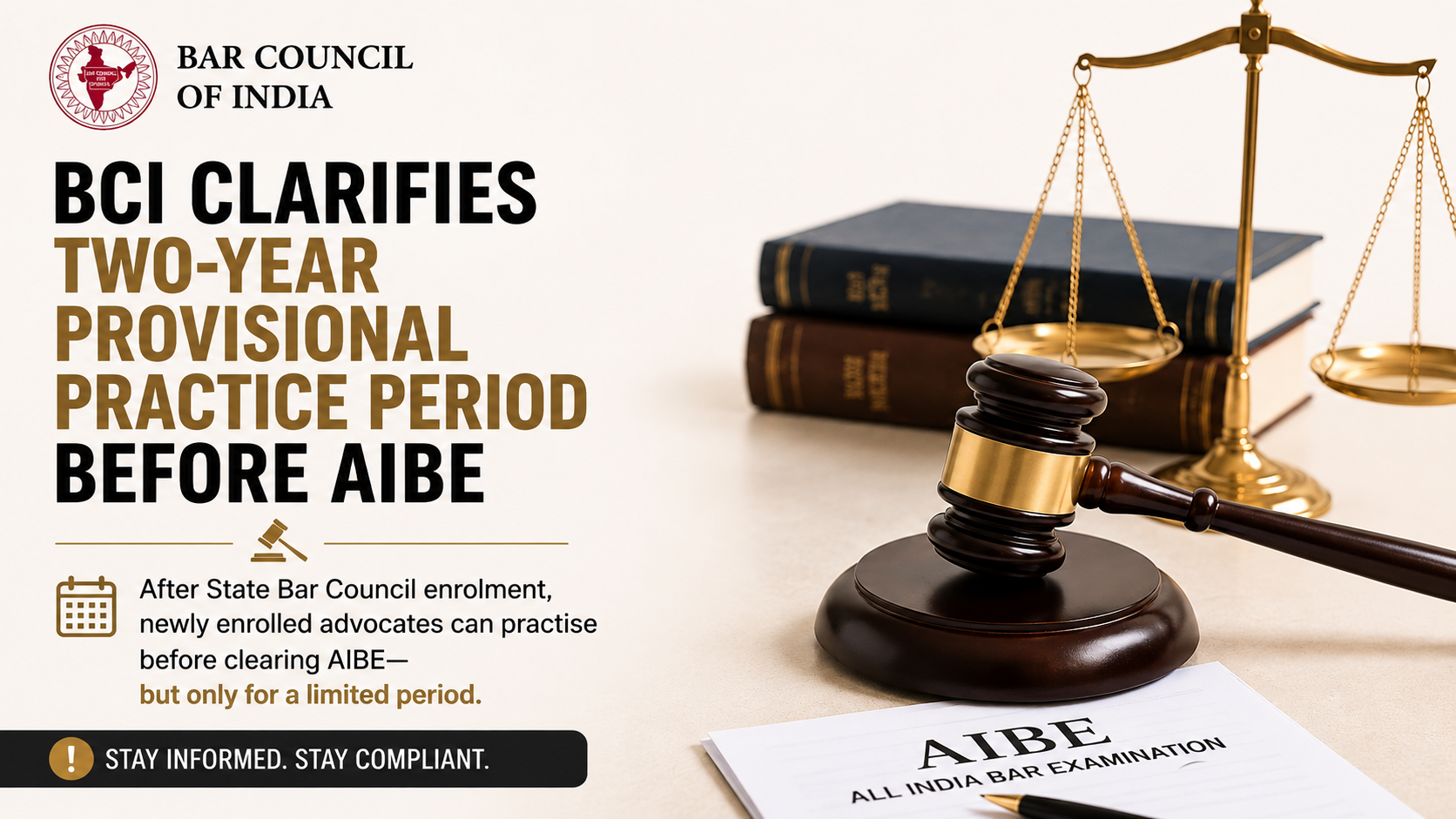
The Bar Council of India has clarified that newly enrolled advocates are permitted to practice law immediately after enrolling with their respective State Bar Council, even if they have not yet cleared the All India Bar Examination (AIBE).
However, this permission is provisional and is available only for a limited period, generally up to two years from the date of enrollment.
The All India Bar Examination (AIBE) is conducted by the Bar Council of India to assess whether a newly enrolled advocate possesses the minimum professional knowledge required to practice law in India.
After successfully clearing the examination, advocates receive the Certificate of Practice, enabling them to continue practicing without the provisional limitation.
The journey typically follows these steps:
1️⃣ Complete your LL.B. degree.
2️⃣ Enroll with your State Bar Council.
3️⃣ Begin practicing as an advocate under provisional enrollment.
4️⃣ Appear for the AIBE.
5️⃣ Clear the examination.
6️⃣ Receive your Certificate of Practice.
During this period, newly enrolled advocates can:
- ✅ Practice law.
- ✅ Appear before courts as permitted under the applicable rules.
- ✅ Gain practical legal experience.
- ✅ Work under senior advocates.
- ✅ Continue preparing for the AIBE.
However, this provisional right is not permanent.
If the AIBE is not cleared within the applicable provisional period, the advocate's provisional right to practice is affected until the examination is successfully passed.
Yes.
One important clarification is that candidates are not limited to a single attempt.
If an advocate does not qualify in one attempt, they can continue appearing for future AIBE examinations until they pass.
However, the ability to take the examination multiple times does not automatically extend the provisional right to practice beyond the prescribed period.
❌ Myth 1
"You cannot practice until you clear AIBE."
✅ Reality: You may begin practicing immediately after enrollment with the State Bar Council under provisional enrollment.
❌ Myth 2
"If I fail AIBE once, I lose my career."
✅ Reality: Candidates can continue attempting AIBE until they qualify.
❌ Myth 3
"The two-year period means I have only one chance."
✅ Reality: The two-year period relates to provisional practice, not to the number of AIBE attempts.
This clarification helps:
- 🎓 Final-year law students.
- ⚖️ Newly enrolled advocates.
- 🏛️ Law firms recruiting fresh graduates.
- 📚 Law colleges guiding students.
- 👨⚖️ Young professionals planning their legal careers.
Understanding these rules helps avoid unnecessary confusion and ensures advocates remain compliant with BCI regulations.
✔️ Enroll with your State Bar Council.
✔️ You can begin practicing immediately after enrollment.
✔️ This right is provisional.
✔️ The provisional practice period is generally valid for up to two years.
✔️ Clear the AIBE within the prescribed period to obtain your Certificate of Practice.
✔️ You may continue attempting AIBE until you successfully qualify.
✔️ Stay updated with official notifications issued by the Bar Council of India.
The BCI's clarification provides much-needed certainty for aspiring advocates entering the legal profession. While newly enrolled lawyers can begin practicing immediately after enrollment, clearing the AIBE remains an essential milestone for obtaining a regular Certificate of Practice.
For every law graduate, understanding these rules early can help ensure a smooth transition from legal education to professional practice.
📌 Disclaimer: This article is intended for informational purposes only and is based on the Bar Council of India's rules and clarifications. Since regulatory provisions may be amended from time to time, readers are advised to refer to the latest official notifications issued by the Bar Council of India before making any professional decisions.