Introduction
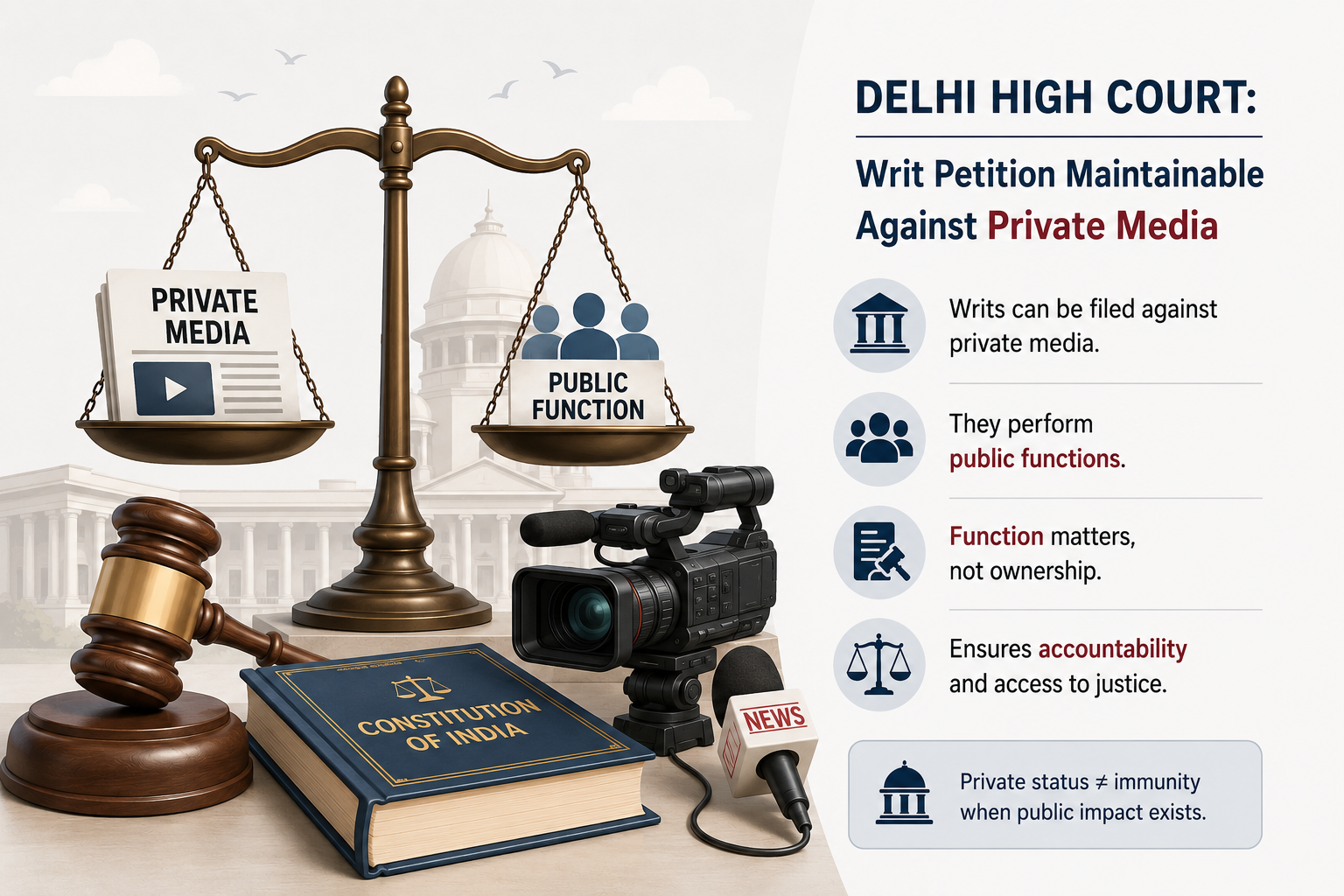
In an important ruling concerning constitutional remedies and the scope of writ jurisdiction, the Delhi High Court recently observed that a writ petition can be maintained against private media entities if they perform public functions.
The judgment raises a crucial constitutional question:
Can private entities be challenged under writ jurisdiction?
Traditionally, writ petitions are associated with actions against the State or public authorities. However, this ruling highlights that even private bodies may become subject to judicial scrutiny when they perform functions that affect public interest.
Background of the Case
The matter before the Delhi High Court involved questions regarding the maintainability of a writ petition against a private media organization.
The key issue was whether a private media entity, despite not being a government body, could still be subject to writ jurisdiction under constitutional law.
This required the Court to examine the nature of the functions performed by such organizations.
Key Legal Issue
The central question before the Court was:
Can a writ petition be filed against a private media house?
The answer depended on whether the entity was merely private in structure or whether it performed functions carrying public significance.
The Court focused on the concept of public function.
Understanding Writ Jurisdiction
Writ jurisdiction allows High Courts and the Supreme Court to issue directions, orders, or writs for enforcement of legal and fundamental rights.
In India, writ powers arise under:
- Article 32 of the Constitution of India
- Article 226 of the Constitution of India
Generally, writs are issued against:
- Government bodies
- Public authorities
- Statutory institutions
However, courts have also recognized that private bodies may fall under writ jurisdiction in certain circumstances.
Court’s Observation
The Delhi High Court observed that the nature of the function performed is more important than the formal status of the institution.
This means:
A private entity may still be subject to writ jurisdiction if it performs functions that significantly affect public rights or public interest.
The Court noted that media organizations play a major role in shaping public discourse, influencing democratic processes, and serving public interest.
Because of this public-facing role, certain actions of private media entities may invite judicial scrutiny.
Public Function Doctrine
The ruling highlights the importance of the Public Function Doctrine.
Under this principle, a private body can be treated similarly to a public authority when it performs duties closely connected with public welfare or public obligations.
Examples may include entities involved in:
- Public communication
- Education
- Essential services
- Regulatory functions
The focus is not ownership alone.
The focus is on function.
Why This Judgment Matters
This ruling is significant because it expands discussion around accountability of private institutions operating in spaces that deeply affect public life.
The judgment reinforces an important constitutional principle:
Private status does not automatically grant immunity from judicial review.
Where public functions are involved, courts may step in.
This is especially relevant in sectors like:
- Media
- Education
- Healthcare
- Digital platforms
Legal Significance
The decision may influence future litigation involving private organizations performing public-facing roles.
It may strengthen arguments related to:
- Accountability
- Transparency
- Constitutional oversight
- Access to remedies
This ruling could also shape future debates on the role of private institutions in democratic governance.
Conclusion
The Delhi High Court’s ruling marks an important development in constitutional law by reaffirming that writ jurisdiction is not restricted solely to government authorities.
When private entities perform public functions, they may also be subject to constitutional scrutiny.
The judgment strengthens the principle that accountability must follow public impact.
As private institutions increasingly influence public life, courts will continue to play a key role in defining the boundaries between private autonomy and public responsibility.
#DefendInk #DelhiHighCourt #ConstitutionalLaw #WritJurisdiction #LegalNews