Disclaimer
This article is intended for legal awareness and educational purposes only. The criminal case discussed below is still pending before the competent court. The allegations remain under judicial examination, and no final determination of guilt or innocence has been made. The grant of bail is a procedural order and should not be interpreted as an acquittal or as a finding on the merits of the allegations.
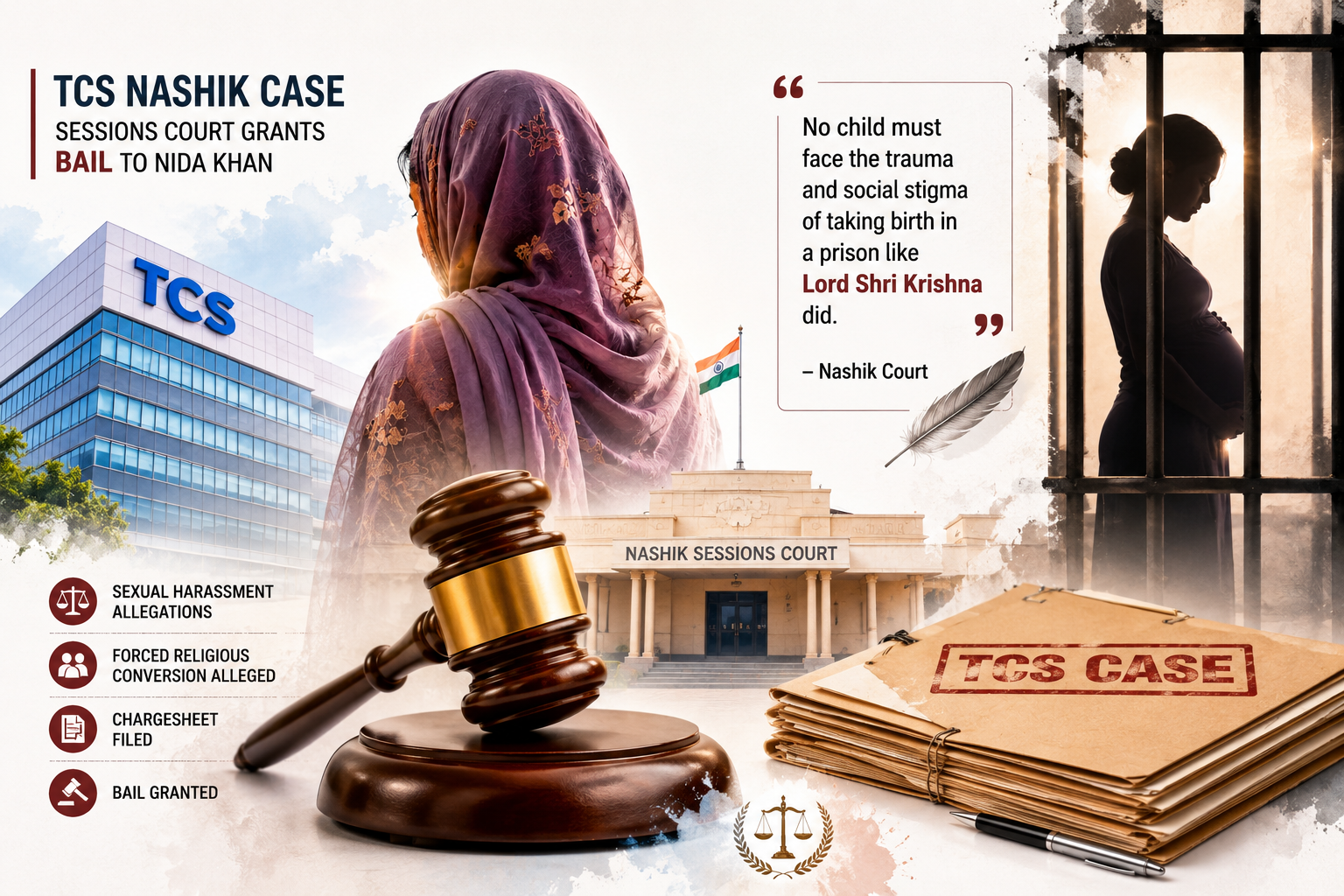
A Sessions Court in Nashik recently drew national attention while granting bail to Nida Khan, one of the accused in the widely discussed TCS Nashik case.
What made the order widely shared was not only the grant of bail, but also the Court's observation:
"No child should face the trauma and social stigma of taking birth in a prison like Lord Shri Krishna did."The observation has generated widespread discussion about bail jurisprudence, humanitarian considerations, and the rights of unborn children during criminal proceedings.
The TCS Nashik case arose from allegations made by a woman employed at a Tata Consultancy Services (TCS)-linked BPO facility in Nashik.
According to the prosecution, the complaint includes allegations relating to:
- Sexual harassment
- Forced religious conversion
- Criminal intimidation
- Other offences under applicable criminal laws
Multiple individuals were named during the investigation, and the matter has remained under active judicial scrutiny.
The allegations are yet to be tested during trial, and the accused continue to be presumed innocent unless proven guilty in accordance with law.
The bail application before the Sessions Court was not a trial on the allegations.
Instead, the Court had to decide a narrower legal question:
Should the accused remain in custody while the criminal case continues?
Indian courts consider several factors while deciding bail, including:
- Stage of investigation
- Filing of the charge sheet
- Possibility of influencing witnesses
- Risk of absconding
- Health and humanitarian circumstances
- Interests of justice
According to reports, the Court noted that:
- The investigation had substantially progressed.
- The charge sheet had already been filed.
- Continued custodial detention was not considered necessary for investigation.
The Court also considered the fact that Nida Khan was pregnant.
While discussing this aspect, the Court observed that an unborn child should not suffer the consequences of incarceration before birth, leading to the widely quoted reference to Lord Shri Krishna.
The observation was made in the context of the child's welfare rather than the merits of the criminal allegations.
The Court referred to the well-known narrative in Hindu tradition that Lord Krishna was born inside a prison.
The reference was used as a humanitarian illustration rather than as a legal principle.
The Court's underlying concern was that an unborn child should not experience avoidable trauma or social stigma because of circumstances beyond the child's control, where the legal requirements for granting bail are otherwise satisfied.
No.
This is one of the most common misconceptions in criminal law.
A bail order does not determine guilt or innocence.
It only decides whether an accused should remain in custody while the criminal proceedings continue.
The prosecution must still prove its case during trial, and the defence will have the opportunity to contest the allegations before the court.
The final outcome will depend entirely on the evidence presented.
The order has attracted public attention because it touches on several important legal principles:
1. Presumption of Innocence
Every accused person is presumed innocent until proven guilty through a fair trial.
2. Humanitarian Considerations in Bail
Courts may consider pregnancy, health, age, and other humanitarian factors while deciding whether continued detention is necessary.
3. Rights of the Unborn Child
The Court's observation reflects the broader principle that children should not unnecessarily bear the consequences of pending criminal proceedings involving their parents.
4. Bail Is About Liberty, Not Acquittal
The decision reinforces that bail is a procedural safeguard balancing individual liberty with the interests of justice.
The case also raises broader questions for India's criminal justice system:
- How should courts balance personal liberty with serious criminal allegations?
- When should humanitarian grounds influence bail decisions?
- To what extent should the welfare of an unborn child be considered?
- How can courts protect both victims' rights and the constitutional rights of accused persons?
These questions continue to shape modern bail jurisprudence.
- Bail is not a declaration of innocence.
- Humanitarian circumstances may be considered while deciding bail.
- Pregnancy can be a relevant factor in appropriate cases, but each case is decided on its own facts.
- The criminal trial continues despite the grant of bail.
- Final guilt or innocence will be determined only after the evidence is examined during trial.
The Nashik Sessions Court's bail order has become one of the most discussed legal developments of recent weeks because it combines criminal procedure with humanitarian considerations.
While the Court's reference to Lord Shri Krishna attracted public attention, the legal significance of the order lies in a broader principle:
Bail decisions must balance the seriousness of allegations with constitutional protections, procedural fairness, and humanitarian concerns—without prejudging the outcome of the trial.
As the TCS Nashik case proceeds, the criminal allegations will ultimately be decided on evidence presented before the trial court.
Sources
- LiveLaw – Report on the bail order and court's observations.
- Bar & Bench – Coverage of the TCS Nashik case and bail proceedings.
- The Indian Express – Reporting on the Sessions Court's bail decision.
Tags
#DefendInk #LegalNews #BailLaw #CriminalLaw #TCSNashikCase #IndianLaw #CourtUpdate #LegalAwareness #JusticeSystem #RuleOfLaw