When Courtrooms Meet the Internet
Court proceedings are increasingly reaching the public through digital platforms. While this promotes transparency and legal awareness, it also creates a difficult challenge—what happens when courtroom recordings are uploaded without authorization?
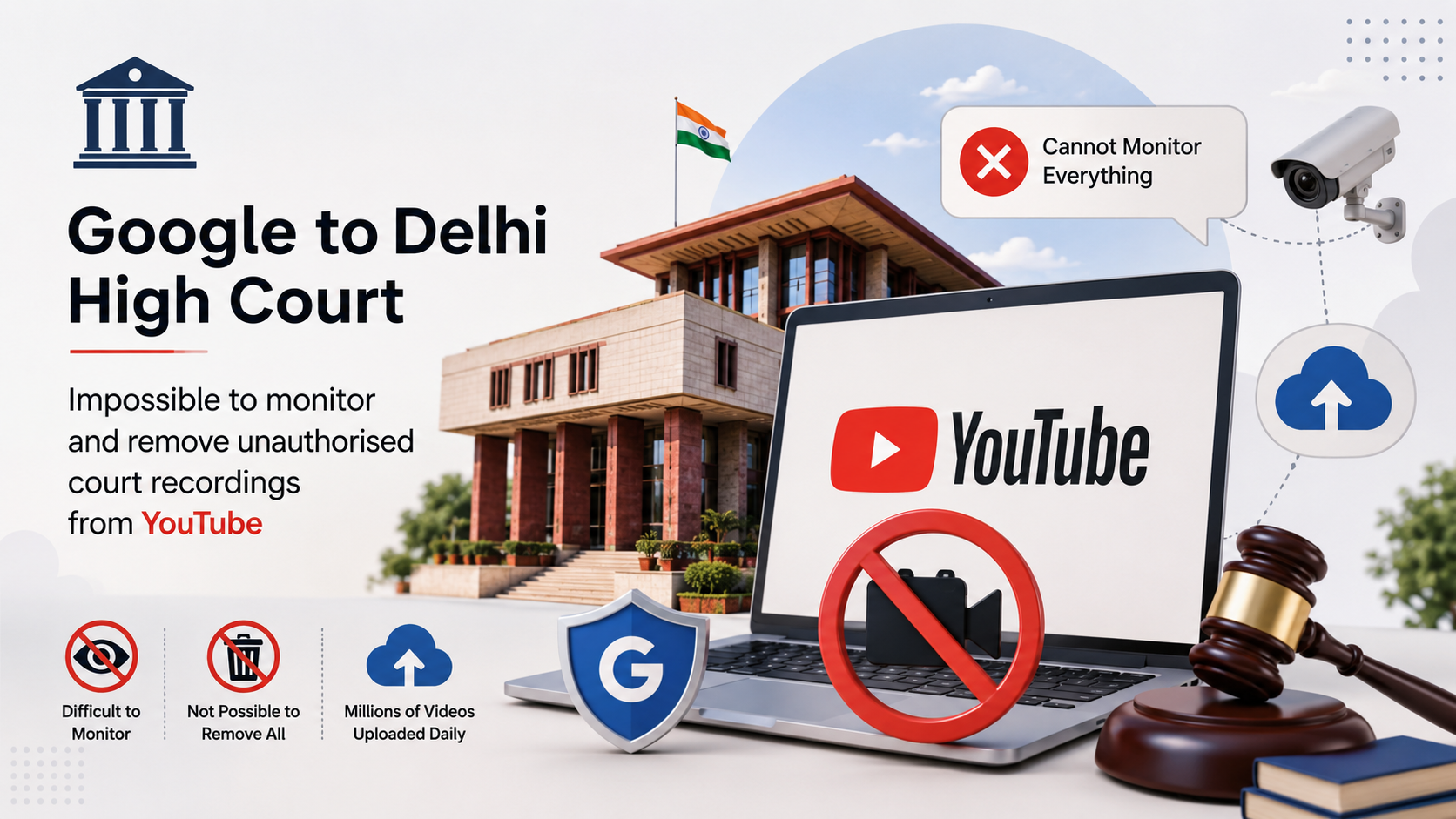
This question recently came before the Delhi High Court, where Google stated that it is practically impossible to continuously monitor and remove every unauthorized recording uploaded to YouTube.
The case highlights an issue faced by nearly every major online platform today:
Can technology companies realistically police millions of uploads every day?
The Background
Court proceedings often involve sensitive legal discussions, witness statements, personal information, and confidential material.
Many courts regulate how hearings may be recorded or shared to protect:
- Privacy of individuals
- Fair trial rights
- Judicial integrity
- Confidential legal proceedings
However, digital platforms have made it easier than ever for users to record, edit, and upload courtroom videos within minutes.
This creates a growing conflict between public access and legal restrictions.
Google's Position Before the Court
During the proceedings before the Delhi High Court, Google submitted that it cannot realistically monitor every video uploaded to YouTube or proactively identify all unauthorized court recordings.
According to Google's submission:
- Millions of videos are uploaded regularly.
- Automated systems cannot always determine whether a courtroom recording is legally authorized.
- Identifying unlawful uploads often depends on valid complaints or court directions.
Google argued that complete real-time monitoring of every upload is not technically feasible.
The Legal Challenge
The dispute raises an important legal question:
Who should bear responsibility for unlawful online content?
Possible stakeholders include:
- Content uploaders
- Platform operators
- Courts
- Regulatory authorities
Finding the right balance between these responsibilities remains one of the biggest challenges in digital governance.
Why This Matters
This issue extends far beyond courtroom recordings.
The same legal questions arise in cases involving:
- Copyright infringement
- Pirated content
- Deepfake videos
- Defamation
- Privacy violations
- AI-generated content
As online platforms continue to grow, completely preventing unlawful uploads becomes increasingly difficult.
The Technology vs. Law Debate
Modern platforms rely heavily on automated moderation systems.
However, artificial intelligence cannot always determine:
- Whether a video has judicial permission
- Whether publication violates court rules
- Whether the content is legally protected
- Whether public interest justifies publication
Human review is often required, making large-scale monitoring extremely challenging.
Why the Court's Consideration Is Important
The Delhi High Court's examination of this issue could influence future discussions on:
- Platform liability
- Digital evidence
- Online content moderation
- Judicial transparency
- Privacy rights
- Technology regulation
The outcome may help shape how courts approach unauthorized recordings in an increasingly digital legal ecosystem.
Key Takeaway
This case illustrates a broader reality of the digital age:
Technology enables instant sharing—but enforcing legal boundaries online remains a complex challenge.
As courts, technology companies, and regulators continue to address these issues, the focus will remain on balancing transparency, privacy, platform responsibility, and freedom of information.
The Delhi High Court's consideration of Google's submission could become an important reference point in the evolving legal framework governing digital platforms and online content moderation.
#DefendInk #DelhiHighCourt #YouTube #CyberLaw #DigitalGovernance #ContentModeration #PrivacyLaw #TechnologyLaw #LegalNews #IndianLaw