The Core Issue
As courts increasingly move toward digital systems, online case tracking has become a standard expectation for litigants.
But an important question arises:
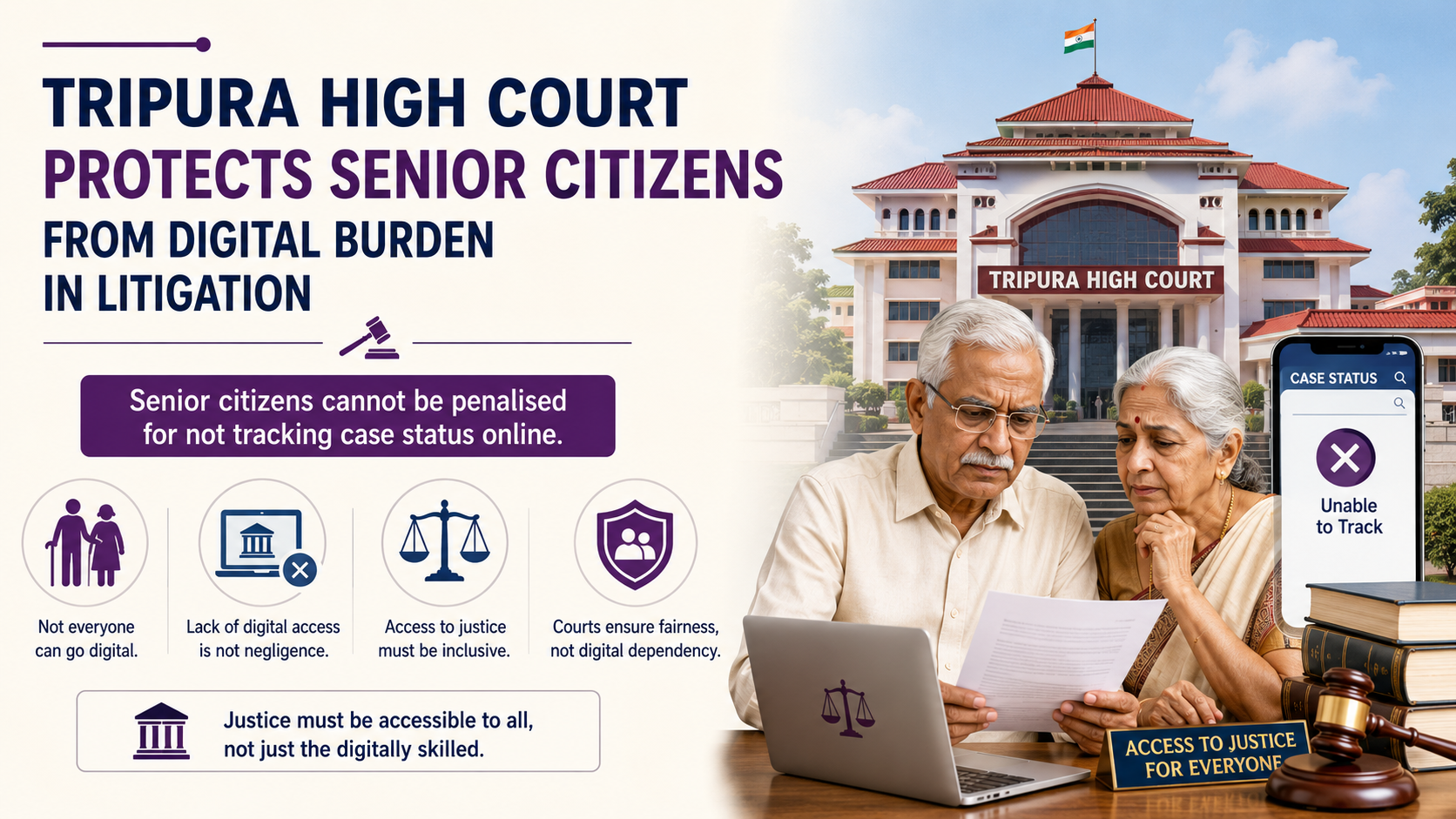
Can senior citizens be penalised simply because they fail to track their case status online?
The Tripura High Court recently addressed this issue and gave a clear answer:
No.
The Court held that senior citizens cannot be unfairly penalised for failing to monitor case updates through online systems.
Why This Case Matters
India’s judicial system is rapidly adopting digital tools.
Today, litigants can access:
- Case status
- Hearing dates
- Orders
- Cause lists
through online court portals.
While digital access improves efficiency, not everyone can adapt equally.
Senior citizens often face challenges such as:
- Limited digital literacy
- Difficulty using technology
- Restricted internet access
- Physical limitations
This creates a serious access-to-justice concern.
What the Court Recognized
The Tripura High Court recognized an important reality:
Digital accessibility cannot be treated as universal accessibility.
Just because information is available online does not mean every litigant can reasonably access it.
The Court emphasized that procedural fairness must consider practical realities, especially for vulnerable groups like senior citizens.
The Court’s Stand
The High Court made it clear that senior citizens should not suffer adverse consequences merely because they could not track their cases online.
The ruling reinforces that procedural expectations must remain fair, reasonable, and inclusive.
Courts cannot ignore the human side of access to justice.
Technology may support justice delivery—but it cannot become a barrier to justice.
Bigger Legal Principle
This ruling goes beyond one case.
It highlights a larger legal principle:
Digitization should improve access, not exclude people.
Technology is a tool.
It cannot replace fairness.
Judicial systems must ensure that modernization does not disadvantage:
- Senior citizens
- Digitally excluded individuals
- Vulnerable litigants
Why This Judgment Is Important
This decision sends a powerful message.
As legal systems become more digital, inclusion must remain a priority.
Efficiency matters.
But justice matters more.
Courts must ensure that no individual loses legal protection simply because they are unable to navigate technology.
Final Takeaway
The Tripura High Court’s ruling is an important reminder that justice must remain accessible to everyone—not just to those comfortable with digital systems.
In a rapidly digitizing legal ecosystem, balancing innovation with inclusivity remains essential.
Because access to justice should never depend solely on digital literacy.
#DefendInk #TripuraHighCourt #LegalNews #AccessToJustice #IndianLaw