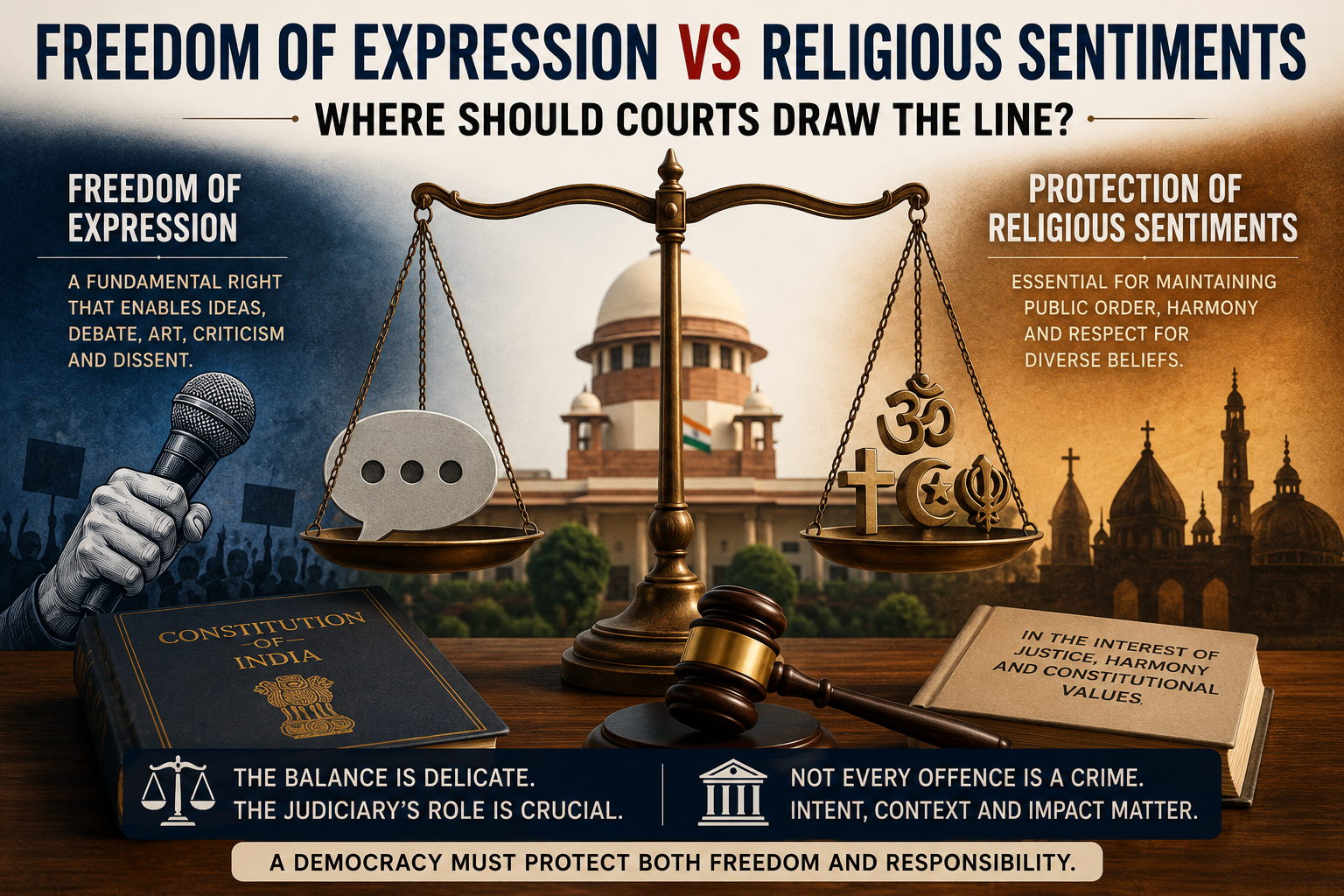
⚖️ Freedom of Expression vs Religious Sentiments: Where Should Courts Draw the Line?
Every few months, a familiar legal debate resurfaces: the clash between freedom of expression and the protection of religious sentiments. This issue has come to the forefront with various incidents that spark public outcry.
Following these events, complaints are filed, FIRs are registered, and the matter often reaches the courts. At the heart of many of these disputes lies a challenging question:
How should the law balance freedom of expression with the protection of religious sentiments?
📜 The Constitutional Starting Point
The Indian Constitution guarantees freedom of speech and expression under Article 19(1)(a). This freedom allows individuals to:
- Express opinions and ideas.
- Engage in artistic and creative endeavors.
- Participate in public discourse.
However, this right is not absolute. Article 19(2) permits reasonable restrictions in the interests of:
- Public order.
- Decency or morality.
- Contempt of court.
- Defamation.
- Incitement to an offense.
Consequently, courts often determine where legitimate expression ends and unlawful conduct begins. The Supreme Court in Shreya Singhal v. Union of India (2015) emphasized that restrictions must be proportionate and cannot be arbitrary. The Court declared that the mere possibility of causing offense cannot be a ground for imposing restrictions on speech.
⚖️ Is Offence Alone Enough?
One recurring observation made by courts is that merely feeling offended does not automatically render an act criminal. In a diverse society, encountering opinions, artistic works, and viewpoints that one disagrees with is inevitable. If criminal prosecution were allowed every time someone claimed offense, freedom of expression would be severely compromised.
The law, therefore, looks beyond the reaction itself. Courts frequently examine:
- The context of the expression.
- The intent behind the act.
- The nature and effect of the expression on society.
🎯 Why Intention Matters
Intent plays a significant role in cases involving religious sentiments. There is a legal distinction between:
- Intent to offend religious sentiments.
- Intent to engage in healthy discourse or artistic expression.
This distinction is crucial because criminal law generally seeks to punish intentional wrongdoing. The Supreme Court in Ranjit D. Bhatia v. Union of India (2000) affirmed that freedom of expression must be protected unless it is demonstrated that the expression intends to incite violence or hatred. This aligns with the principle that intent is a key element in establishing culpability in criminal law.
🏛️ The Court's Difficult Role
Courts are not asked to decide whether everyone agrees with a statement, nor are they expected to protect every individual from being offended. Instead, courts must determine whether conduct crosses the legal threshold established by law. This balancing exercise is rarely straightforward:
The challenge lies in protecting both constitutional freedoms and public order. The Supreme Court in Vishaka v. State of Rajasthan (1997) highlighted the importance of balancing competing rights and interests. The Court stated that the protection of women's rights should not undermine the rights of others, showcasing the nuanced approach required in such cases.
🤔 The Bigger Question
In a country as diverse as India, disagreements are inevitable. Religions, cultures, traditions, and beliefs often intersect in complex ways. The real question may not be whether someone was offended, but rather:
Should criminal law intervene every time an offense is taken? Or should it intervene only when there is evidence of deliberate intent to incite hatred, violence, or disorder?
The Supreme Court in Indian Express Newspapers (Bombay) Pvt. Ltd. v. Union of India (1985) reiterated that freedom of expression is essential for a democratic society and must be preserved unless there is a compelling justification for restriction. This case highlighted the need for a robust and clear standard when determining the legality of expressions that may offend certain groups.
💭 Final Thoughts
The debate between freedom of expression and the protection of religious sentiments is unlikely to fade. Each new controversy tests these boundaries anew. Yet, one principle continues to guide the discussion:
A democratic society must protect both freedom and responsibility. Finding the correct balance remains one of the judiciary's most challenging tasks. In this regard, legal practitioners and courts must engage in continuous dialogue to evolve interpretations that reflect the changing societal landscape.
💬 Discussion
Where do you think the line should be drawn? Should the law focus primarily on public reaction, or should intention remain the decisive factor? What role do you see the judiciary playing in navigating these complex issues?