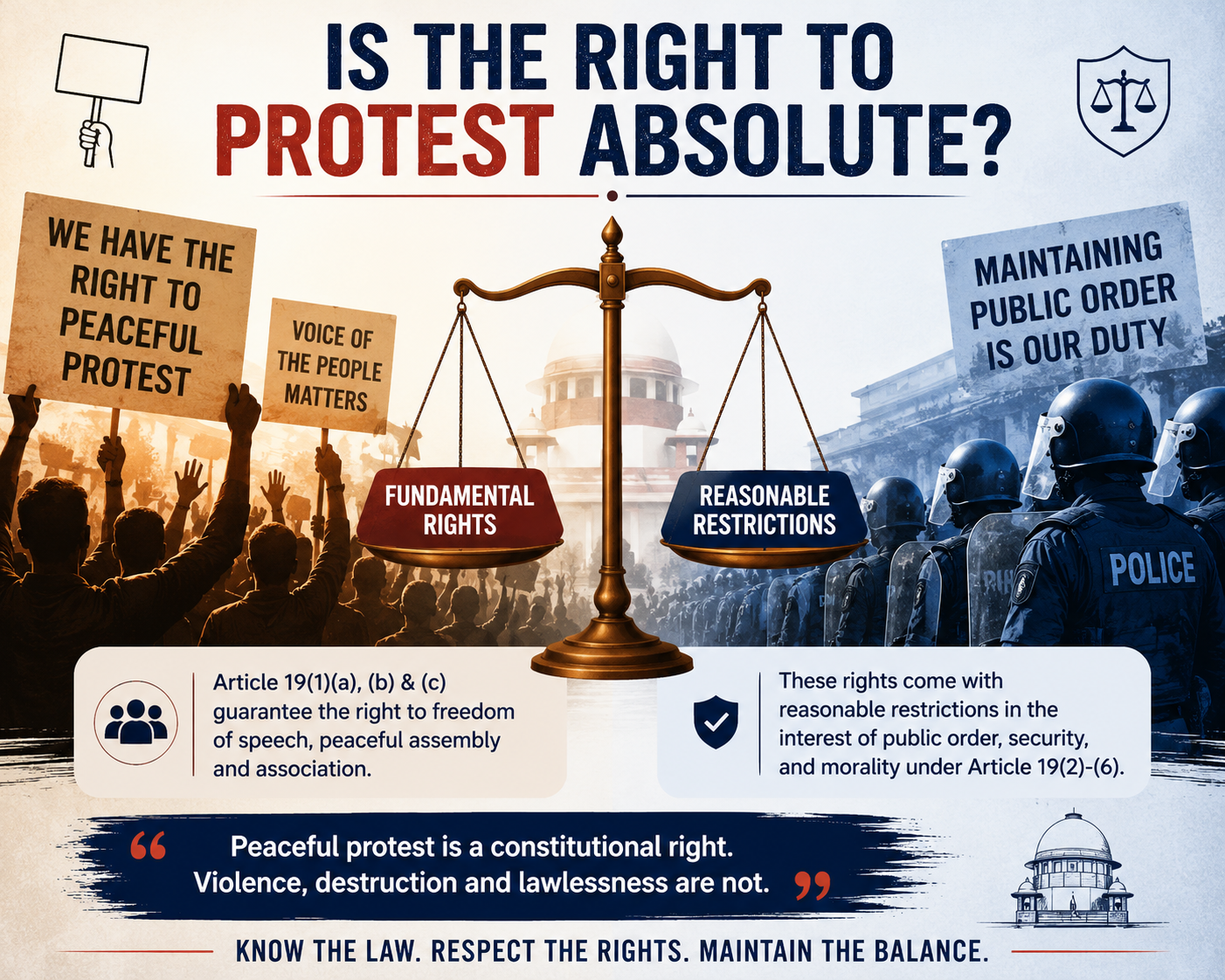
Article 19(1)(b) of the Constitution of India guarantees the right to peaceful assembly. However, this right is not absolute and exists alongside reasonable restrictions that can be imposed in the interest of public order, security, and morality, as outlined in Article 19(2). The State is empowered to impose restrictions that are necessary for the protection of the public interest and to prevent disorderly conduct.
The Supreme Court of India has consistently emphasized the importance of balancing civil liberties with the necessity of maintaining law and order. In the landmark case of Ramlila Maidan Incident, In re, (2012) 5 SCC 1, the Court held that while the right to protest is fundamental, it must be exercised in a manner that does not disrupt public peace or order. The Court stated that the right to protest should be exercised responsibly, ensuring that it does not infringe upon the rights of others.
Furthermore, in the case of Hussain v. Union of India, (2017) 5 SCC 688, the Supreme Court reiterated that the right to assemble peacefully and without arms is a vital aspect of democracy, yet it must be balanced against the duty of the State to maintain public order and security. The Court emphasized that the State has the right to impose lawful restrictions on this right when faced with threats to public order or national security.
This raises a crucial question: where should the balance be drawn between individual rights to protest and the State's obligation to maintain public order? The Court in Vishaka v. State of Rajasthan, (1997) 6 SCC 241, reiterated that the exercise of rights should not infringe on the rights of others, thus suggesting a need for responsible exercise of the right to assemble. The judgment underscores the importance of ensuring that protests do not lead to violence or public disorder, which could undermine the very rights being exercised.
In practical terms, the Courts have also laid down guidelines for the conduct of protests. For instance, the Supreme Court, in the Shreya Singhal v. Union of India, (2015) 5 SCC 1 case, highlighted that while free speech and assembly are fundamental rights, they must be exercised in a manner that does not lead to hatred or incitement to violence. The Court's approach encourages peaceful dialogue and negotiation as preferable alternatives to violent protests.
We invite you to share your views on this critical issue. How do you perceive the balance between the right to protest and the need for public order? Can there be a framework that allows for both expression and security without infringing on fundamental rights?