Disclaimer
This article is intended for legal awareness and educational purposes only. It does not constitute legal advice. Laws may vary depending on the facts of each case. Readers should consult a qualified legal professional for case-specific guidance.
Imagine someone walks into a police station to report an offence.
One of the first questions police officers determine is:
Is the offence cognizable or non-cognizable?
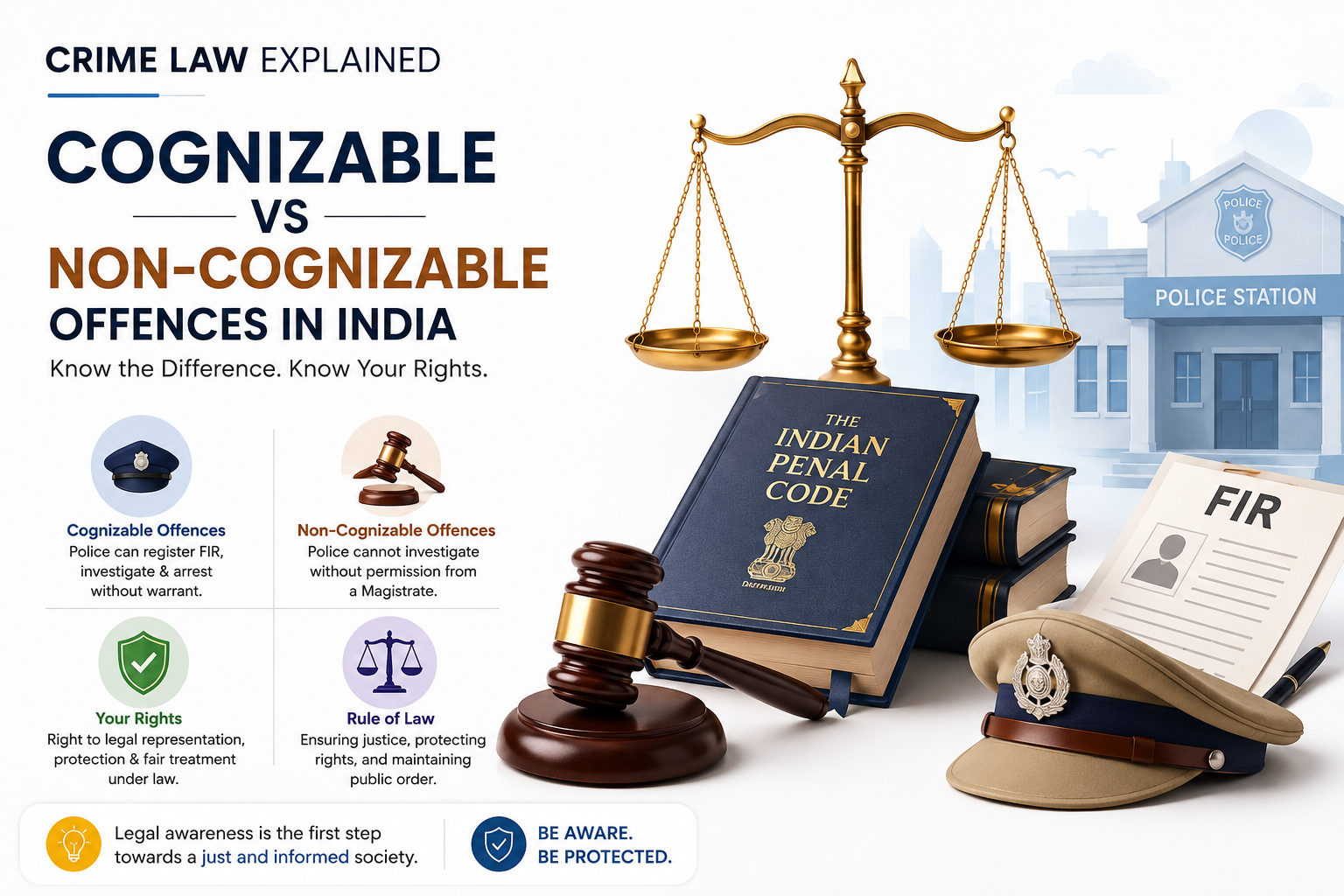
This classification decides whether police can immediately investigate, arrest without a warrant, or whether they must first obtain permission from a Magistrate.
Many people are unaware of this distinction, yet it affects every stage of a criminal investigation.
Understanding the difference is essential for every citizen.
A cognizable offence is a serious criminal offence where the police have the legal authority to:
- Register an FIR.
- Start an investigation immediately.
- Arrest the accused without a warrant (subject to applicable legal safeguards).
These offences usually involve significant harm to individuals or society.
Common Examples
- Murder
- Rape
- Kidnapping
- Human trafficking
- Robbery
- Terrorism
- Acid attacks
- Dowry death
Because these offences pose a serious threat, the law allows police to act quickly without waiting for prior court approval.
A non-cognizable offence is generally less serious.
In such cases, police cannot investigate or arrest without prior permission from a Magistrate, except where the law provides otherwise.
Instead, the complaint is recorded, and further action usually requires judicial authorization.
Common Examples
- Defamation
- Public nuisance
- Simple hurt (in many circumstances)
- Minor assault
- Criminal intimidation in certain situations
This ensures judicial oversight before criminal investigation begins.
The classification affects several important legal rights.
Cognizable OffenceNon-Cognizable OffencePolice can register an FIRComplaint is recorded before further actionInvestigation can begin immediatelyMagistrate's permission is generally requiredArrest without warrant may be permitted under lawArrest generally requires legal authorizationUsually involves serious crimesUsually involves comparatively less serious offences
What Is an FIR?An FIR (First Information Report) is the formal document prepared by police after receiving information about a cognizable offence.
It marks the beginning of a criminal investigation.
An FIR generally contains:
- Details of the incident
- Date and time
- Place of occurrence
- Names of persons involved (if known)
- Nature of the offence
Every individual has important legal protections during criminal proceedings.
These include:
- The right to know the grounds of arrest.
- The right to consult a lawyer.
- The right to be produced before a Magistrate within 24 hours after arrest, except where lawful exceptions apply.
- The right to apply for bail where permitted by law.
- Protection against unlawful detention.
Knowing these rights helps ensure fairness within the criminal justice system.
❌ Every complaint becomes an FIR.
Not always. FIRs generally relate to cognizable offences.
❌ Police can arrest anyone without reason.
No.
Even where arrest without a warrant is legally permitted, it must comply with statutory requirements and constitutional safeguards.
❌ Every criminal case results in imprisonment.
Incorrect.
The outcome depends on evidence, investigation, trial, and judicial findings.
Crime law serves several purposes:
- Protects citizens from unlawful acts.
- Maintains public order.
- Punishes offenders through due process.
- Protects the rights of victims.
- Safeguards the constitutional rights of accused persons.
The criminal justice system seeks to balance effective law enforcement with fairness and the rule of law.
✅ Cognizable offences allow immediate police investigation.
✅ Non-cognizable offences generally require Magistrate approval before investigation.
✅ Every accused person has constitutional and legal rights.
✅ Understanding basic criminal law helps citizens respond appropriately during legal situations.
Crime law is more than a set of legal provisions—it is the framework that protects society while ensuring justice is delivered fairly.
Whether you are a citizen, student, or legal professional, understanding the basics of criminal law can help you make informed decisions and safeguard your legal rights.
Legal awareness is not just for lawyers—it is for everyone.
Tags
#CrimeLaw #CriminalLaw #IndianLaw #LegalAwareness #KnowYourRights #LegalEducation #Justice #LawStudents #DefendInk #LegalNews