Introduction
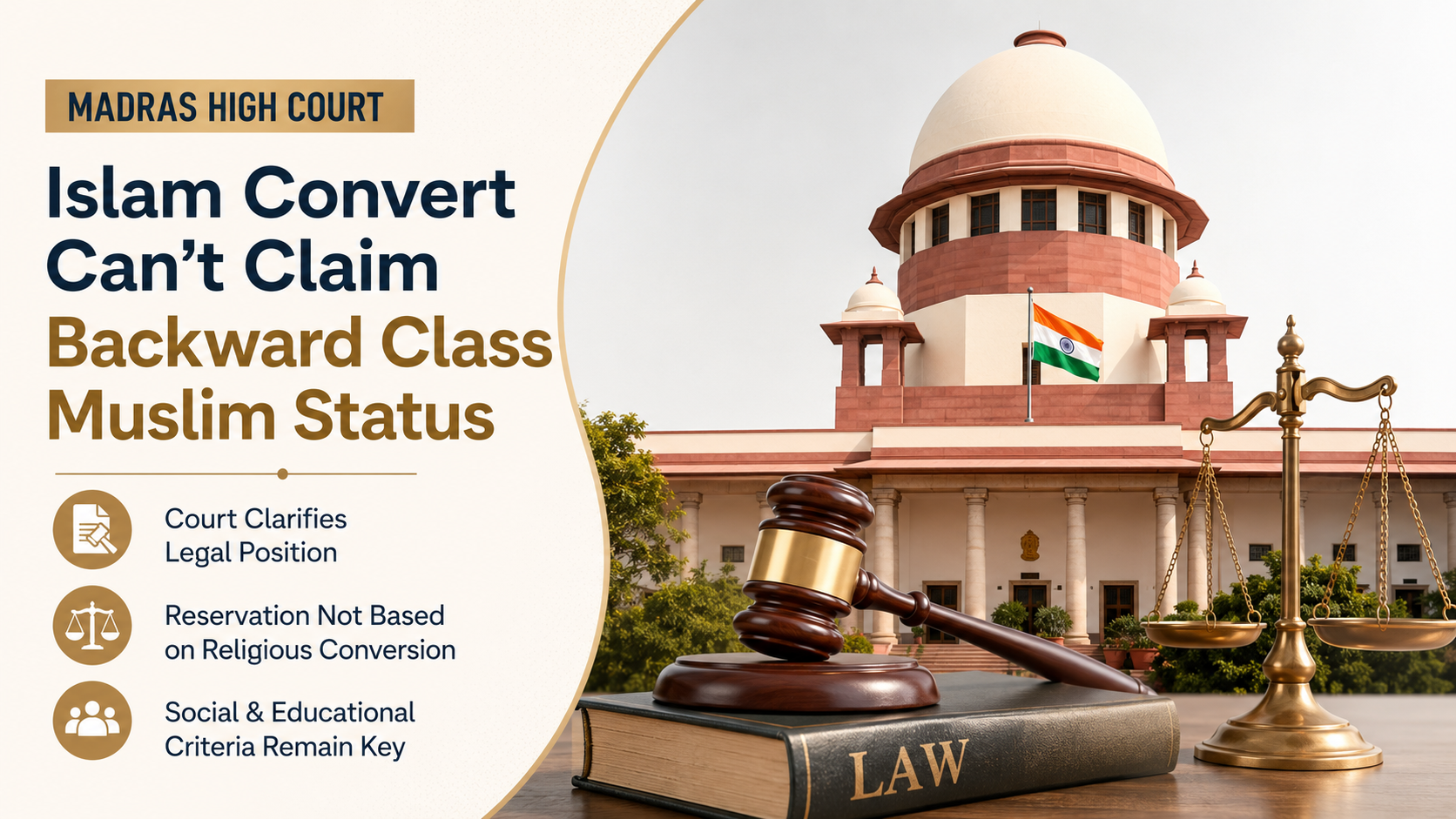
In a significant ruling concerning reservation law and social classification, the Madras High Court recently observed that a person who converts to Islam cannot automatically claim Backward Class Muslim status solely based on conversion.
The judgment addresses an important legal issue at the intersection of religion, social identity, and reservation policy.
The key question before the Court was:
Does conversion to Islam automatically entitle a person to claim reservation benefits available to Backward Class Muslims?
The Madras High Court answered this in the negative.
Background of the Case
The case involved an individual who had converted to Islam and later sought recognition under the Backward Class Muslim category for the purpose of availing reservation benefits.
The petitioner argued that after embracing Islam, he should be considered eligible for benefits extended to socially and educationally backward Muslim communities.
The matter eventually reached the Madras High Court for judicial determination.
Key Legal Issue
The central legal issue before the Court was:
Can a person claim Backward Class Muslim status merely on the basis of religious conversion?
This required the Court to examine:
- Reservation policy framework
- Social and educational backwardness criteria
- Legal effect of religious conversion
- Eligibility for caste/community-based reservation benefits
Court’s Observation
The Madras High Court emphasized that reservation benefits are not granted purely on the basis of religion.
Instead, reservation under Backward Class categories depends on legally recognized criteria such as:
- Social backwardness
- Educational disadvantage
- Community classification under state policy
The Court observed that merely changing religion does not automatically alter a person’s social status for reservation purposes.
In other words, conversion by itself is insufficient to claim reservation benefits reserved for specific backward communities.
Court’s Ruling
The Madras High Court held that conversion to Islam alone does not automatically confer Backward Class Muslim status.
The Court clarified that eligibility must be determined based on legally recognized classification criteria and applicable reservation policies.
Thus, a person cannot claim reservation benefits solely because of religious conversion unless all required legal conditions are satisfied.
Why This Judgment Matters
This ruling is significant because it clarifies an important principle in reservation law:
Religion alone does not determine reservation eligibility.
The judgment reinforces that reservation benefits are linked to recognized social and educational disadvantage—not merely religious identity.
This decision may have wider implications in cases involving:
- Religious conversion
- Reservation claims
- Community certificates
- Social classification disputes
Legal Significance
The ruling strengthens judicial interpretation of reservation laws by emphasizing structured eligibility criteria.
It highlights that courts carefully distinguish between:
- Religious identity
- and
- Statutory reservation eligibility
This distinction is crucial for maintaining the legal integrity of reservation frameworks.
Conclusion
The Madras High Court’s ruling serves as an important clarification on the legal relationship between religious conversion and reservation eligibility.
The judgment makes it clear that conversion to Islam does not automatically entitle an individual to Backward Class Muslim status.
Reservation claims must be examined within the framework of law, policy, and established eligibility criteria.
As debates around identity, religion, and affirmative action continue, this judgment adds an important legal perspective to the ongoing discussion.
#DefendInk #LegalNews #ReservationLaw #MadrasHighCourt #IndianLaw