📢 Disclaimer
This article is for legal awareness and informational purposes only. It is based on publicly reported court proceedings. The filing of a Public Interest Litigation (PIL) represents the petitioner's requests before the Court and does not reflect the Court's final decision or findings. The matter remains subject to judicial consideration.
Can the State provide life-saving medical care to a fasting protester without violating their personal autonomy?
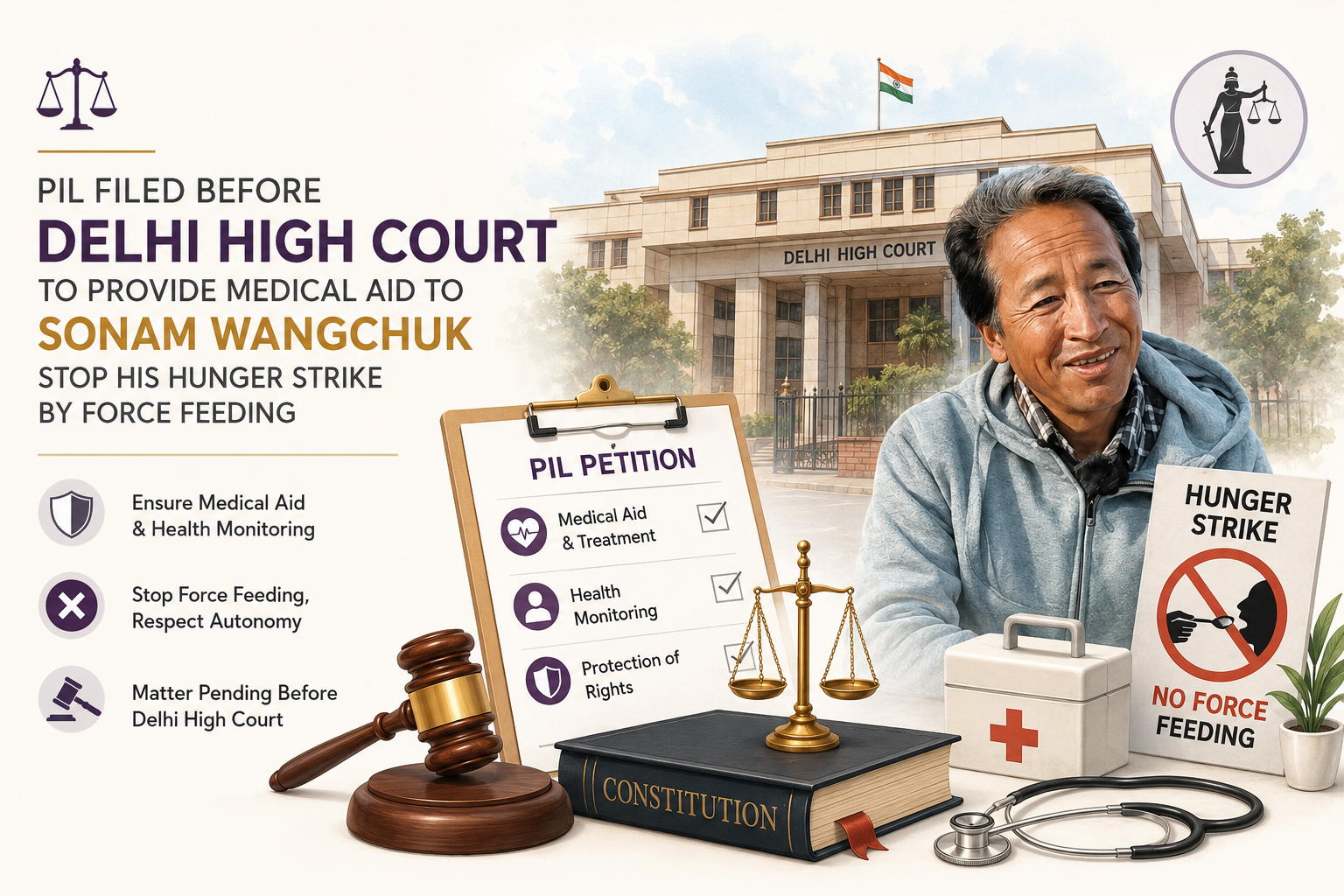
This complex constitutional question has now reached the Delhi High Court, where a Public Interest Litigation (PIL) seeks urgent intervention concerning Sonam Wangchuk's ongoing hunger strike.
The petition requests the Court to ensure medical assistance while also seeking directions to prevent force-feeding, bringing into focus the delicate balance between the right to life, personal liberty, bodily autonomy, and the State's duty to protect life.
Sonam Wangchuk is an engineer, education reformer, innovator, and environmental activist from Ladakh. He is widely known for:
- 🏔️ Sustainable development initiatives in the Himalayan region.
- 📚 Innovative education models.
- 🌱 Climate and environmental advocacy.
- 🇮🇳 Public campaigns concerning Ladakh's constitutional and ecological issues.
His recent hunger strike has attracted national attention.
According to reports, the Public Interest Litigation requests the Delhi High Court to:
✅ Ensure appropriate medical examination and treatment for Sonam Wangchuk.
✅ Direct authorities to monitor his health during the hunger strike.
✅ Prevent force-feeding while respecting his bodily autonomy.
The petition asks the Court to safeguard both health and constitutional rights.
Although the Court has not yet decided the matter, the petition raises several important legal issues.
❤️ 1. Right to Life (Article 21)
Article 21 of the Constitution guarantees protection of life and personal liberty.
The Court may consider whether authorities have a duty to provide medical care when an individual's health is at serious risk.
🧍 2. Bodily Autonomy
Indian constitutional jurisprudence recognizes personal autonomy and dignity as important components of Article 21.
The case raises the question:
Can medical treatment be forced upon an individual who voluntarily refuses food as part of a peaceful protest?
✊ 3. Right to Protest
Peaceful protest is recognized as an important democratic freedom, subject to reasonable legal restrictions.
The Court may need to balance:
- Freedom of expression.
- Public order.
- Health and safety concerns.
- Individual liberty.
🏥 4. Duty of the State
Governments have a responsibility to protect life and maintain public health.
The legal challenge is determining how far that responsibility extends when an individual knowingly undertakes a prolonged hunger strike.
This case is significant because it sits at the intersection of several constitutional principles.
It could influence future discussions involving:
- ⚖️ Constitutional rights.
- 🩺 Medical ethics.
- ✊ Peaceful protests.
- 🏛️ State responsibility.
- 👨⚖️ Judicial intervention during public movements.
The Court's approach may offer guidance for similar situations involving prolonged fasts and public demonstrations.
✅ A PIL has been filed before the Delhi High Court.
✅ The petition seeks medical assistance for Sonam Wangchuk while opposing force-feeding.
✅ The matter raises important constitutional questions involving Article 21, bodily autonomy, and the State's duty to protect life.
✅ As of now, the Court has not delivered its final decision.
Cases like this demonstrate that constitutional law often requires balancing competing rights rather than choosing one over another.
The Court may ultimately consider:
- Should personal autonomy prevail?
- Does the State have an overriding obligation to preserve life?
- How should democratic protest and medical ethics coexist?
These questions lie at the heart of constitutional governance.
The Delhi High Court's consideration of this PIL goes beyond one individual's hunger strike.
It raises broader constitutional questions about how India balances personal liberty, peaceful protest, medical ethics, and the State's responsibility to protect life.
Whatever the outcome, the case is likely to contribute to ongoing discussions on the limits of State intervention and the protection of fundamental rights during public protests.
⚠️ Disclaimer
The filing of a PIL does not indicate that the Court has accepted the petitioner's claims or granted any relief. The matter is pending before the Delhi High Court, and the final decision will depend on judicial examination of the facts and applicable law.
📚 Sources
- Bar & Bench – PIL filed before Delhi High Court to provide medical aid to Sonam Wangchuk, stop his hunger strike by force feeding.
- Delhi High Court case proceedings (subject to availability).
- Publicly available legal reporting on the matter.
🏷️ Suggested Tags
#DelhiHighCourt #SonamWangchuk #PIL #ConstitutionalLaw #RightToLife #Article21 #LegalNews #IndianLaw #PublicInterestLitigation #DefendInk