Introduction
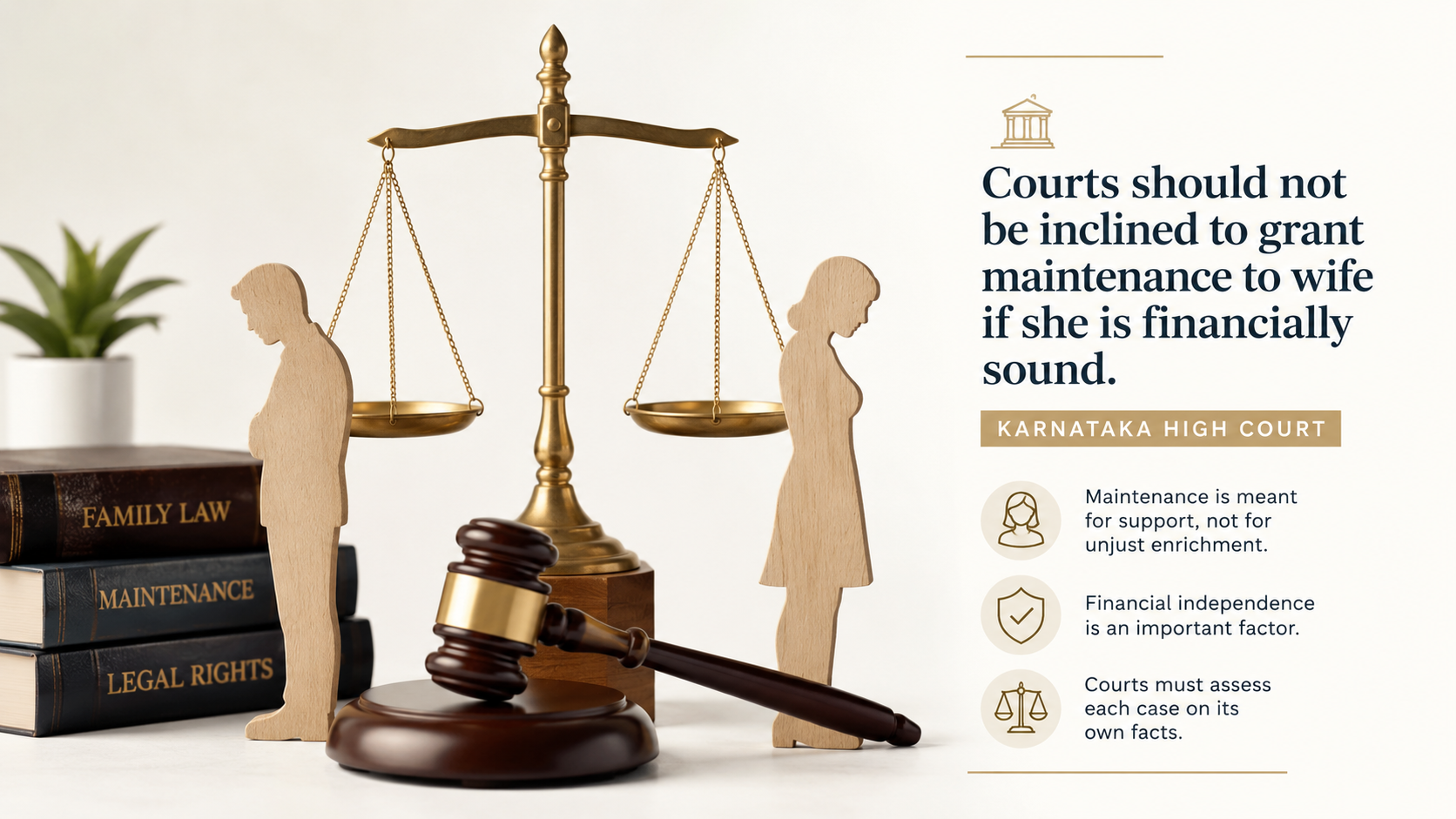
In a significant observation, the Karnataka High Court stated that courts should not automatically grant maintenance to a wife if she is financially sound and capable of supporting herself.
This ruling has sparked discussions around the evolving legal interpretation of maintenance laws in India, especially in the context of financial independence and gender-neutral fairness.
What Did the Court Say?
The court emphasized that the primary purpose of maintenance is to prevent financial hardship and ensure support for a dependent spouse.
However, if the wife is:
- Financially stable
- Gainfully employed
- Capable of maintaining her lifestyle independently
then courts must carefully assess whether maintenance is genuinely required.
The court observed that maintenance should not become an automatic entitlement.
Why This Matters
This observation reflects changing social and economic realities.
Traditionally, maintenance laws were framed to protect women who were financially dependent after marriage or separation.
But today, many women are:
- Well-educated
- Professionally employed
- Financially independent
This creates an important legal question:
Should maintenance be granted solely based on marital status, or should financial dependency remain the key factor?
Key Legal Principle
The central principle remains clear:
Maintenance is meant for support, not for unjust enrichment.Courts generally consider several factors before deciding maintenance:
- Income of both spouses
- Standard of living during marriage
- Financial liabilities
- Dependency status
- Earning capacity
Each case depends heavily on its facts.
Broader Legal Debate
This judgment has revived a larger debate around fairness in matrimonial disputes.
One side argues:
Maintenance laws exist to protect vulnerable spouses from financial distress.
Another side argues:
If both spouses are earning well, maintenance claims should be assessed more objectively.
The discussion is increasingly moving toward equity over assumption.
Impact on Future Cases
This observation may influence future maintenance disputes by encouraging courts to:
- Examine financial records more closely
- Focus on actual dependency
- Prevent misuse of maintenance provisions
It also signals a gradual shift toward a more balanced interpretation of family law.
Final Thoughts
The Karnataka High Court’s observation highlights an important shift in legal thinking.
As society evolves, family law must adapt to changing realities while maintaining fairness and justice.
The focus should remain on genuine need, financial dependency, and equitable relief.
Community Discussion
What are your thoughts?
Should maintenance depend strictly on financial dependency?
Or should marital obligations continue regardless of earning capacity?
Share your views below.
#FamilyLaw #MaintenanceLaw #KarnatakaHighCourt #LegalUpdate #DefendInk #IndianLaw