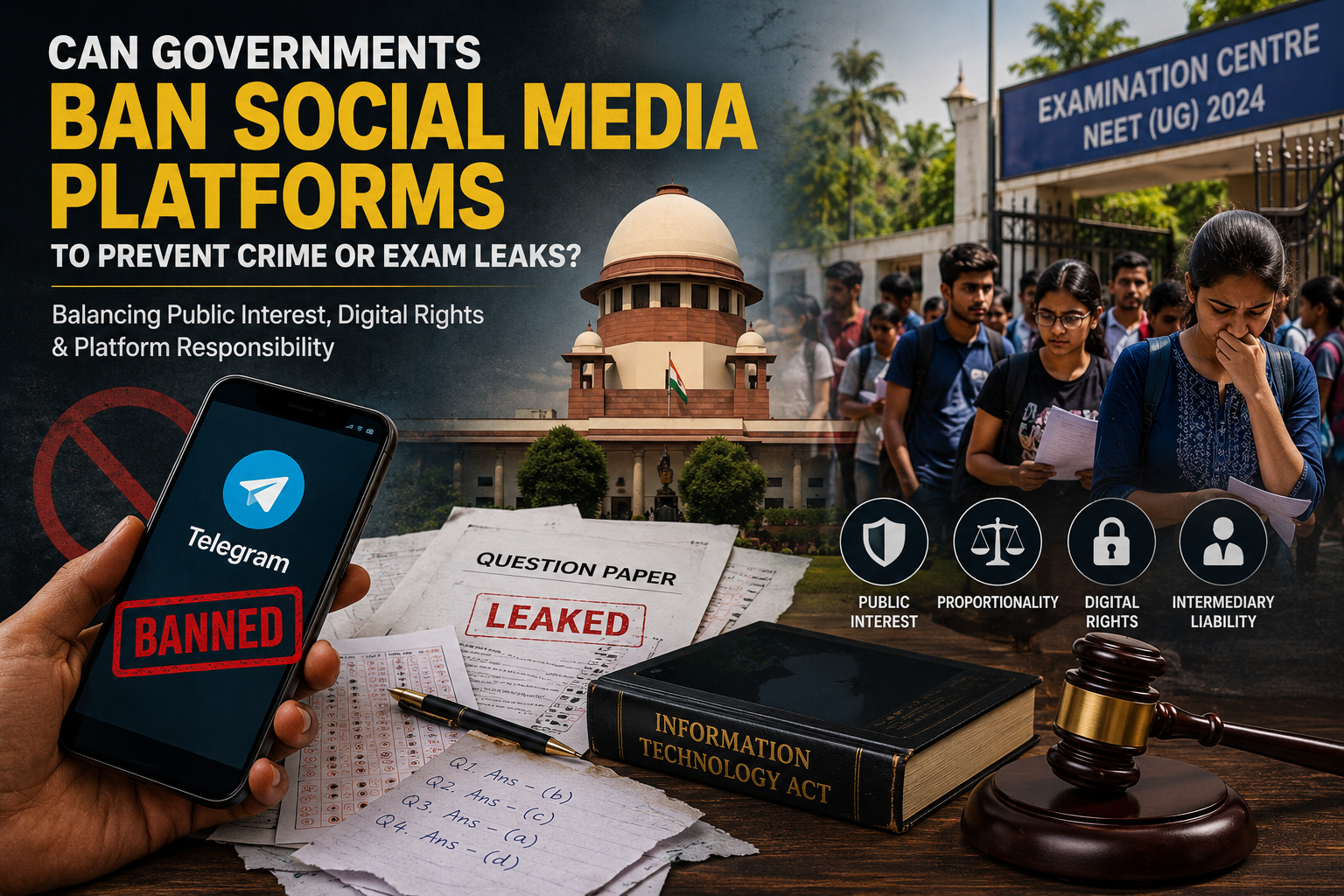
Can Governments Ban Social Media Platforms To Prevent Crime Or Exam Leaks?
In recent times, the question has arisen: Can the government temporarily block a platform utilized by millions to prevent exam leaks? This query highlights critical considerations regarding the balance between public interest and digital freedom.
Key Issues at Hand
The debate centers around the implications of such actions on civil liberties and the effectiveness of government measures in curbing illegal activities. The challenge lies in determining whether the potential benefits of banning a platform outweigh the risks of infringing on individual rights. A thorough examination of the legal framework and its application in real-life scenarios is essential.
The NEET Re-examination Controversy
The controversy surrounding the NEET re-examination is a pertinent example of these issues. Allegations surfaced that the messaging platform Telegram was used to disseminate exam questions, leading the government to contemplate a temporary ban on the service. This situation has sparked widespread discussions about the extent of governmental authority in regulating digital communication in educational contexts. The implications of this case highlight the need for a balanced approach that protects both the integrity of the examination process and the rights of individuals to communicate freely.
Legal Framework
The Information Technology Act, 2000 establishes a framework for the regulation of online platforms. Notably, Section 69A empowers the government to block access to specific online content in the interest of sovereignty, integrity, security, or public order. However, this power must be wielded with caution to ensure that it does not violate the fundamental right to freedom of speech and expression as guaranteed under Article 19(1)(a) of the Constitution of India. The Supreme Court in Shreya Singhal v. Union of India (2015) struck down Section 66A of the IT Act, emphasizing that any restriction on free speech must be reasonable and not arbitrary.
Relevant Case Law
While specific case law relating to this issue is currently limited, judicial interpretations of Article 19(1)(a) and Section 69A provide significant guidance on the boundaries of governmental action in this domain. In the case of Union of India v. Association for Democratic Reforms (2002), the Supreme Court underscored the importance of transparency and accountability in governance, suggesting that blanket bans on communication platforms could hinder the democratic process. Furthermore, in Internet and Mobile Association of India v. Reserve Bank of India (2020), the Supreme Court reiterated the need for a proportionality test when evaluating restrictions on digital platforms.
Practical Insights for Indian Courts
Indian courts must adopt a cautious approach when evaluating government actions to ban social media platforms. They should consider the following principles:
Conclusion
The dilemma of banning social media platforms to prevent crime or exam leaks raises substantial legal and ethical questions. While the government has a duty to safeguard public interest, it must also ensure that any restrictions imposed are proportional and do not infringe upon digital freedoms. A thorough evaluation of the legal framework and relevant precedents is vital for navigating this complex landscape effectively. Courts must balance the needs of public safety with the fundamental rights enshrined in the Constitution, ensuring that any governmental action is both justified and lawful.
#TechnologyLaw #ITAct #Telegram #NEET #SupremeCourt