📢 Disclaimer
This article is for legal awareness and educational purposes only. It is based on publicly reported court proceedings. The observations discussed are those reportedly made by the Bombay High Court during the hearing. The matter remains subject to judicial determination, and this article should not be treated as legal advice or a final judicial finding.
Every decision involving a child carries enormous responsibility.
Whether it is adoption, foster care, or temporary protection, the law expects authorities to act swiftly—but also lawfully.
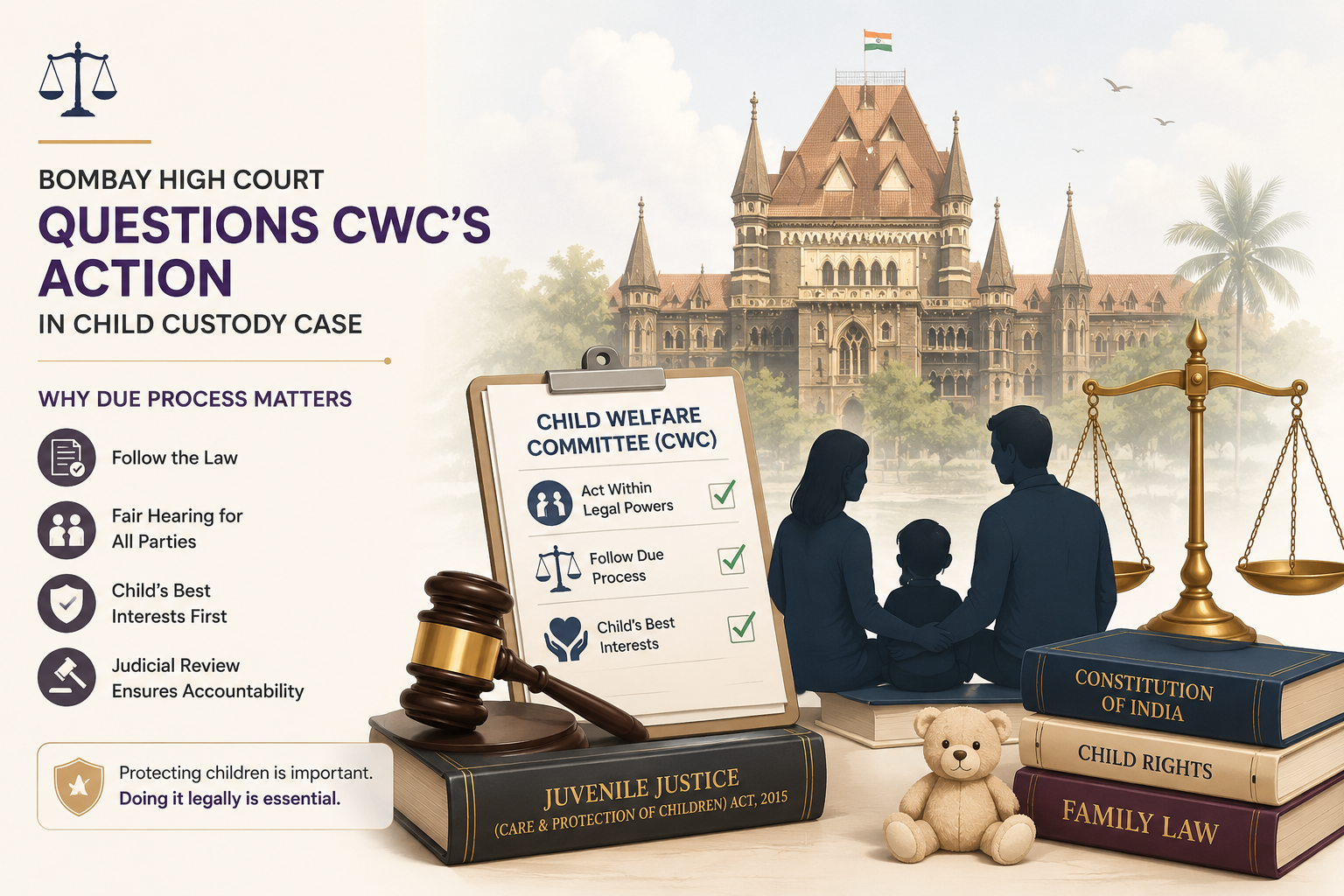
A recent hearing before the Bombay High Court has brought this principle into focus after the Court reportedly questioned the Child Welfare Committee (CWC) over the manner in which custody of a child was taken from adoptive parents.
The case is not merely about one family—it raises larger questions about child welfare, administrative accountability, and the importance of due process.
According to reports, the dispute concerns a child who had been living with adoptive parents.
The Bombay High Court was informed that the Child Welfare Committee (CWC) had taken custody of the child.
During the hearing, the Court reportedly questioned whether the procedure adopted by the CWC complied with the requirements of law and observed that the action appeared to have been taken without following the proper legal process.
The Court's remarks have drawn attention to the limits of administrative authority in matters involving children.
A Child Welfare Committee (CWC) is a statutory body constituted under the Juvenile Justice (Care and Protection of Children) Act, 2015.
Its primary responsibility is to protect children who are:
- 👶 Orphaned
- 🚸 Abandoned
- ⚠️ Neglected
- 🛡️ In need of care and protection
The CWC has significant powers relating to child welfare, rehabilitation, foster care, and institutional care.
However, those powers must always be exercised within the framework of the law.
Although the Court has not delivered its final decision, the reported observations suggest that it was concerned about whether:
- 📄 Proper legal procedures were followed.
- ⚖️ The adoptive parents were given an opportunity to be heard.
- 👶 The child's welfare was assessed through a lawful process.
- 🏛️ The CWC acted within the powers granted under the law.
The Court's concern was not simply about what decision was made—but how it was made.
In child custody matters, the objective is always the welfare of the child.
However, achieving that objective requires adherence to legal safeguards.
Due process generally ensures that:
- Every affected party has an opportunity to present their case.
- Decisions are transparent and reasoned.
- Authorities act within their legal powers.
- Children's rights remain protected.
- Arbitrary administrative action is avoided.
Even well-intentioned decisions must comply with the law.
Adoptive parents who have legally adopted a child are entitled to the protections provided under Indian law.
While every case depends on its facts, they are generally entitled to:
- 📢 Fair notice of adverse proceedings.
- ⚖️ An opportunity to be heard.
- 📄 Decisions based on legal provisions.
- 👨⚖️ Judicial review if they believe authorities acted unlawfully.
These safeguards help ensure fairness while keeping the child's welfare at the centre of every decision.
Indian family law consistently follows one guiding principle:
The best interests of the child are paramount.Courts evaluate several factors, including:
- Emotional well-being.
- Stability of the child's environment.
- Physical safety.
- Educational needs.
- Psychological development.
- Long-term welfare.
Every authority involved in child protection is expected to make decisions that serve these interests.
The case raises several important legal issues that extend beyond the individual dispute.
🏛️ Can statutory authorities bypass due process?
Authorities entrusted with child protection must act lawfully, even in urgent situations.
📋 How should child welfare and procedural fairness be balanced?
Protecting a child and respecting legal safeguards are complementary, not competing, objectives.
👨⚖️ When can courts intervene?
High Courts have the power to review administrative decisions where there are allegations of illegality, procedural irregularity, or violation of legal rights.
This case is significant because it reinforces an important constitutional principle:
No authority—however well-intentioned—is above the law.
The judgment may provide guidance on:
- Child custody procedures.
- Powers of Child Welfare Committees.
- Rights of adoptive parents.
- Administrative accountability.
- Judicial oversight in child welfare matters.
Its impact could extend to future cases involving adoption and child protection across India.
✅ The Bombay High Court reportedly questioned the procedure adopted by the Child Welfare Committee in removing a child from adoptive parents.
✅ The case focuses on whether due process was followed, rather than the final merits of the custody dispute.
✅ Child Welfare Committees have important statutory powers, but those powers must be exercised within the law.
✅ In every custody matter, the child's best interests remain the highest priority.
Child protection is one of the most sensitive responsibilities entrusted to public authorities.
But protecting children is not only about reaching the right outcome—it is also about following the right process.
The Bombay High Court's observations serve as a reminder that fair procedures strengthen, rather than weaken, child welfare.
As the case progresses, its outcome may shape how Child Welfare Committees exercise their powers and how courts safeguard both children's interests and the rule of law.
⚠️ Disclaimer
This matter is currently before the Bombay High Court, and the Court has not yet delivered its final judgment. The observations discussed are based on publicly reported court proceedings and should not be interpreted as conclusive findings against any party.
📚 Sources
- Bar & Bench – Bombay High Court raps CWC for "illegally" taking custody of child from adoptive parents.
- Juvenile Justice (Care and Protection of Children) Act, 2015
- Relevant proceedings before the Bombay High Court (subject to availability).
🏷️ Suggested Tags
#BombayHighCourt #ChildRights #AdoptionLaw #JuvenileJustice #FamilyLaw #ChildWelfare #LegalNews #IndianLaw #LegalAwareness #DefendInk