Disclaimer
This article is for legal awareness and educational purposes only. It summarizes observations made by the Allahabad High Court in a judicial proceeding. The article does not express any opinion on religious beliefs or practices. Readers should refer to the final judgment and applicable laws for complete legal context. (Bar and Bench - Indian Legal news)
Can personal law permit something that a national statute prohibits?
This important constitutional question recently came before the Allahabad High Court while hearing a petition seeking to quash an FIR connected with the proposed marriage of a 16-year-old girl.
The Court's answer was clear:
Statutory child protection laws prevail over personal law when the two conflict. (Bar and Bench - Indian Legal news)
The case arose after police and Child Line officials reportedly received information about the proposed marriage of a 16-year-old Muslim girl in Uttar Pradesh.
Officials reached the location to stop the marriage and take the minor before the Child Welfare Committee.
According to the FIR, the rescue team was allegedly obstructed, threatened, and prevented from performing its official duties. Nineteen individuals later approached the High Court seeking quashing of the FIR. (Bar and Bench - Indian Legal news)
The petitioners argued that under certain interpretations of Muslim personal law, a girl who has attained puberty may be considered competent to marry.
Based on this argument, they contended that the Prohibition of Child Marriage Act, 2006 (PCMA) should not override their personal law in this context. (Bar and Bench - Indian Legal news)
The Allahabad High Court rejected that argument.
The Court observed that:
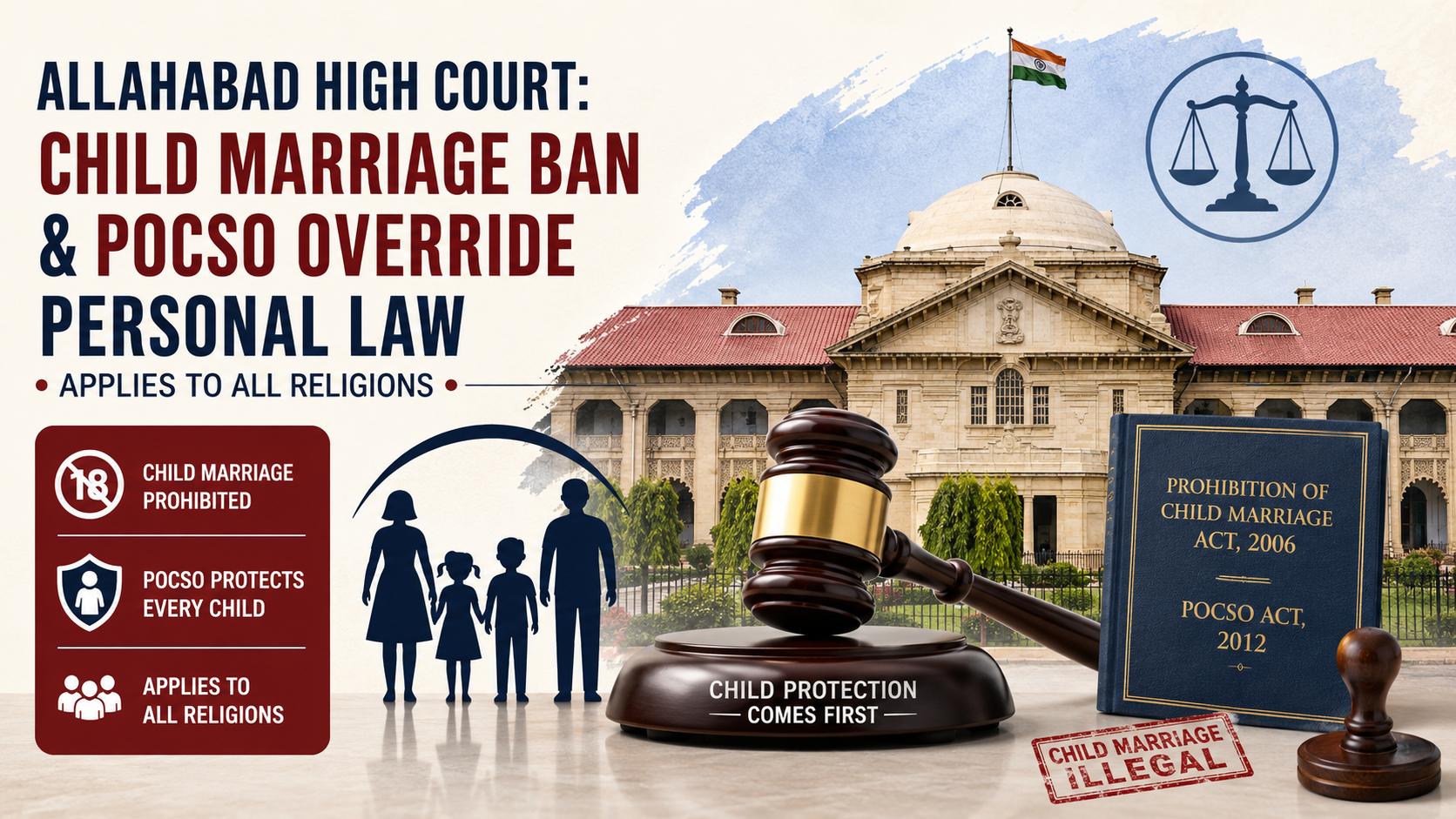
- The Prohibition of Child Marriage Act, 2006 applies to every citizen, irrespective of religion.
- The protections under the Protection of Children from Sexual Offences Act, 2012 (POCSO) cannot be overridden by personal law.
- A personal law permitting marriage at puberty cannot prevail where Parliament has enacted child protection legislation applicable to all citizens. (Bar and Bench - Indian Legal news)
The Court noted that if a person below 18 years is married, marital relations could potentially attract the provisions of the POCSO Act because the Act protects minors from sexual offences irrespective of personal law.
According to the Bench, the PCMA and POCSO are welfare legislations enacted in the interest of child protection and public policy. (Bar and Bench - Indian Legal news)
The judgment emphasized an important legal principle:
Child protection laws enacted by Parliament cannot be diluted by personal law exceptions.
The Court stated that the legal age prescribed under the Prohibition of Child Marriage Act governs all citizens equally, regardless of religion. (Bar and Bench - Indian Legal news)
The ruling is significant because it addresses the relationship between:
- Personal laws
- Child protection legislation
- Constitutional equality
- Public policy
It also reinforces the idea that laws enacted to safeguard children operate uniformly unless Parliament provides otherwise. (Bar and Bench - Indian Legal news)
✅ The Prohibition of Child Marriage Act applies to all citizens.
✅ POCSO protections cannot be overridden by personal law.
✅ Courts may prioritize statutory child protection laws where they conflict with personal law.
✅ The judgment arose while refusing to quash an FIR relating to the alleged obstruction of officials attempting to prevent the marriage of a minor. (Bar and Bench - Indian Legal news)
The Allahabad High Court's ruling reinforces a central principle of Indian law:
When child protection statutes and personal law are in conflict, statutory protections enacted by Parliament prevail.
The judgment is an important development in the continuing discussion on the interaction between personal laws and uniform child protection legislation in India.
Sources
- Bar & Bench – Allahabad HC judgment report
- LiveLaw – Judgment summary
- India Today – News report on the ruling
Suggested Tags:
#DefendInk #AllahabadHighCourt #POCSO #ChildMarriage #IndianLaw #LegalNews #ChildRights #LegalAwareness #ConstitutionalLaw #PCMA