Introduction
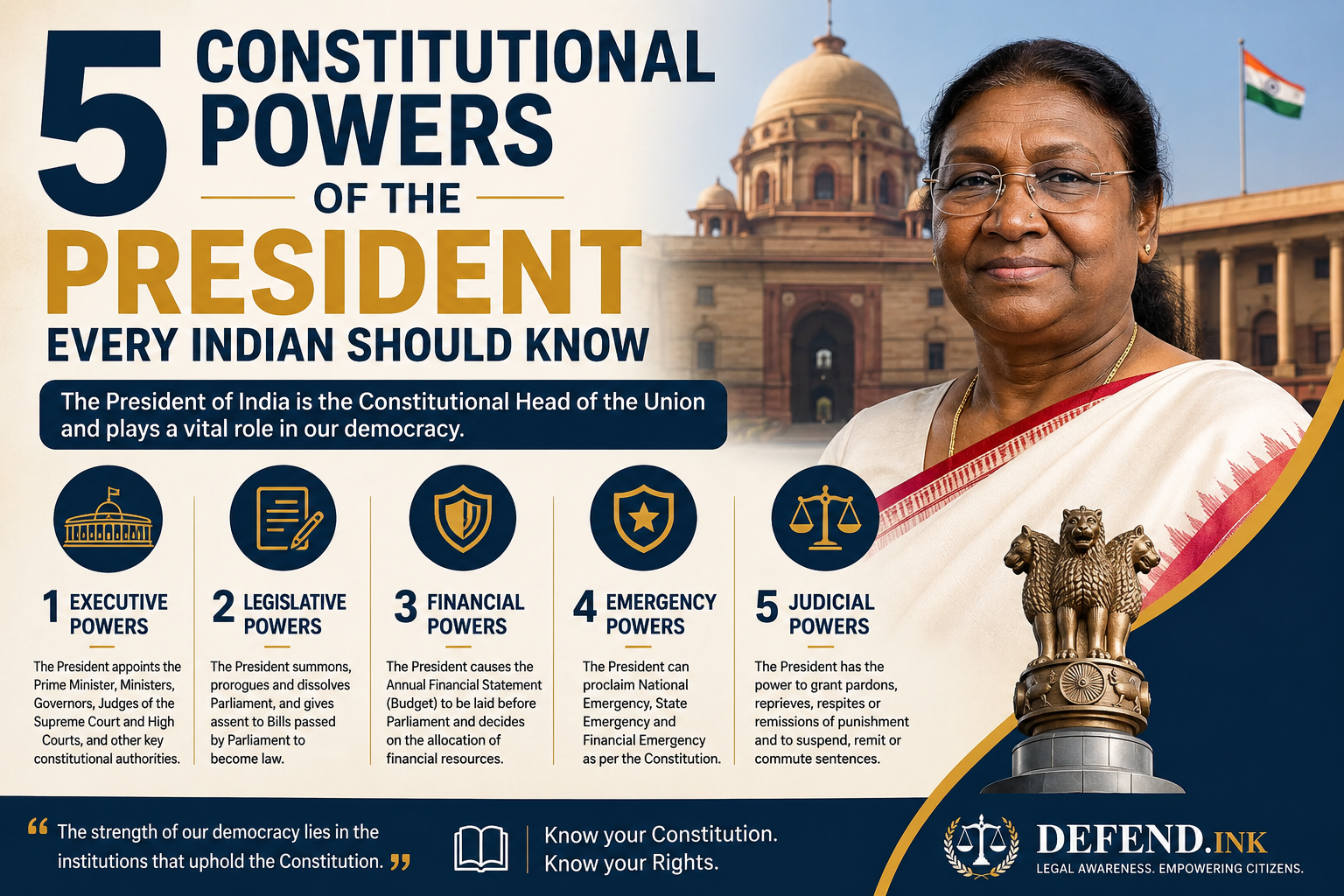
The President of India, as the constitutional head of the state, wields significant powers as outlined in the Constitution of India. These powers are not merely ceremonial; they play a crucial role in the functioning of the government. Understanding these powers is essential for every citizen to appreciate the constitutional framework of India.
1. Executive Power
The President holds the executive power of the Union, which is exercised on the advice of the Council of Ministers headed by the Prime Minister, as per Article 74 of the Constitution. This includes appointing the Prime Minister, other ministers, governors of states, and various other officials.
Case Reference: Shamsher Singh v. State of Punjab, (1974) 2 SCC 831, where the Supreme Court emphasized that the President acts on the advice of the council of ministers, reinforcing the parliamentary system.
2. Legislative Power
The President summons and prorogues Parliament sessions and has the authority to dissolve the Lok Sabha. Additionally, the President's assent is required for a bill to become law. The President can also address both Houses of Parliament at the commencement of the first session after each general election and the first session of each year.
Practical Insight: It is crucial to note that the President can return a bill for reconsideration if it is not a money bill, as provided under Article 111. However, if the bill is passed again by Parliament, the President must give assent.
3. Judicial Power
The President possesses the power to grant pardons, reprieves, respites, or remissions of punishment under Article 72. This power can be exercised in cases involving the death penalty or for those convicted under any law relating to an offense against a law of the Union.
Case Reference: Raja Ram Jaiswal v. State of U.P., (1985) 3 SCC 136, where the Supreme Court discussed the scope of the President's power to grant pardons.
4. Military Power
The President is the Supreme Commander of the Armed Forces. This role includes appointing the chiefs of the Army, Navy, and Air Force. The President can also declare war or conclude peace, subject to the approval of Parliament.
Practical Insight: The exercise of military power must always align with constitutional provisions, and decisions taken in this regard are subject to parliamentary oversight.
5. Emergency Powers
Under Articles 352, 356, and 360, the President can declare a state of emergency in case of war, external aggression, or armed rebellion. During such times, the President can assume greater powers, which include the ability to legislate by ordinance when Parliament is not in session.
Case Reference: Minerva Mills Ltd. v. Union of India, (1980) 3 SCC 625, highlighted the limits on the use of emergency powers to ensure that constitutional provisions remain intact even during emergencies.
Conclusion
The powers of the President of India are vast and varied, playing a pivotal role in the governance and constitutional framework of the country. Understanding these powers not only enhances civic awareness but also underscores the significance of constitutional checks and balances.
For further reading, consider exploring the following resources:
- Constitution of India
- Books on Indian Polity and Governance
- Government publications on the role of the President