Introduction
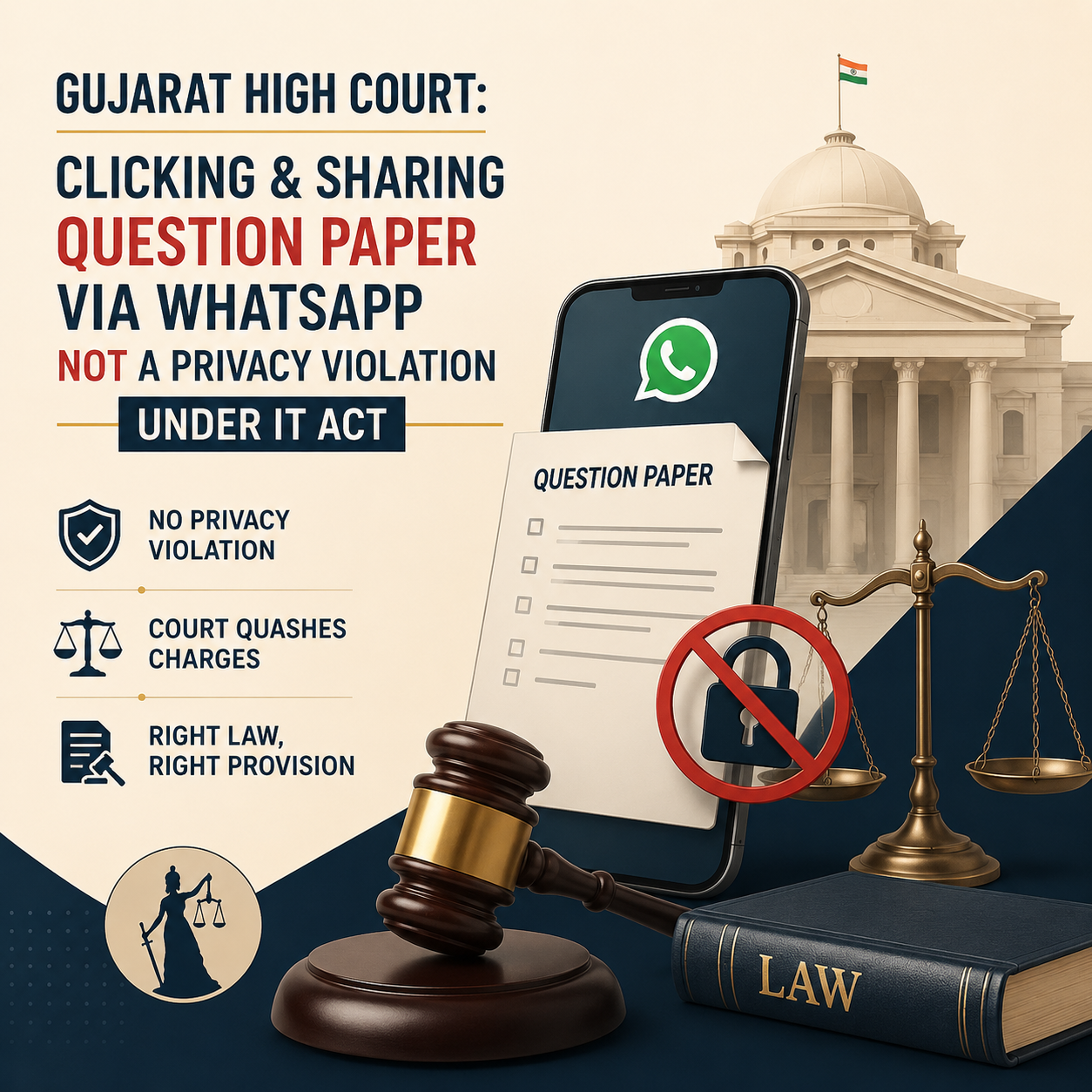
In a significant ruling concerning the scope of privacy protections under India’s Information Technology Act, the Gujarat High Court recently quashed charges of privacy violation against an accused involved in sharing a photograph of an examination question paper through WhatsApp.
The case raises an important legal question:
Does clicking and sharing a question paper amount to violation of privacy under the IT Act?
The Gujarat High Court answered this in the negative, clarifying the boundaries of privacy-related offences in digital law.
Background of the Case
The matter involved allegations against an individual accused of clicking photographs of a question paper during an ongoing examination and sending those images to his brother via WhatsApp.
Authorities registered charges under multiple provisions, including privacy-related offences under the Information Technology Act.
The prosecution argued that capturing and transmitting the question paper electronically constituted an offence involving unlawful digital conduct.
However, the accused challenged the privacy-related charges before the Gujarat High Court.
Key Legal Issue
The central issue before the Court was:
Can photographing and sharing an examination question paper be treated as a violation of privacy under the Information Technology Act?
This required the Court to examine whether a question paper falls within the legal scope of “private area,” “privacy,” or protected personal information under relevant provisions of the IT Act.
Court’s Observation
The Gujarat High Court observed that privacy-related provisions under the Information Technology Act are intended to protect personal privacy, dignity, and sensitive individual information.
The Court noted that these provisions primarily address situations involving:
- Personal privacy violations
- Sensitive personal content
- Unauthorized capture or transmission of private material
- Digital misuse affecting individual dignity
The Court found that an examination question paper does not fall under such protected categories.
Therefore, merely clicking and sharing the question paper—even if wrongful under other laws—did not automatically amount to a privacy violation under the IT Act.
Court’s Decision
Based on its interpretation, the Gujarat High Court quashed the privacy violation charges against the accused.
The Court held that:
- The alleged act may attract liability under other applicable laws
- However, privacy-related provisions under the IT Act were not applicable in this case
This distinction became central to the judgment.
Why This Judgment Matters
This ruling is important because it clarifies the legal scope of privacy offences in India’s digital law framework.
It highlights an important principle:
Not every act involving digital transmission or misuse of electronic communication automatically becomes a privacy violation under the IT Act.
Courts must carefully examine:
- Nature of the content
- Type of information involved
- Whether actual privacy rights were violated
Legal Significance
The judgment may influence future cases involving:
- Digital content sharing
- Electronic evidence
- WhatsApp-based communication offences
- Interpretation of privacy provisions under cyber laws
It also reinforces the need to apply the correct legal provisions based on the nature of the alleged misconduct.
Wrongful conduct and privacy violation are not always legally identical.
Conclusion
The Gujarat High Court’s ruling draws an important distinction between digital misuse and privacy infringement under the Information Technology Act.
While leaking examination material may still attract serious legal consequences, the Court made it clear that such conduct cannot automatically be categorized as a privacy violation unless the legal ingredients of the offence are clearly satisfied.
This case serves as an important reminder that in cyber law, precise legal interpretation matters just as much as technological context.
As digital offences continue to evolve, courts will play a crucial role in defining the boundaries of privacy and cyber liability in India.
#DefendInk #LegalAnalysis #CyberLaw #ITAct #IndianLaw