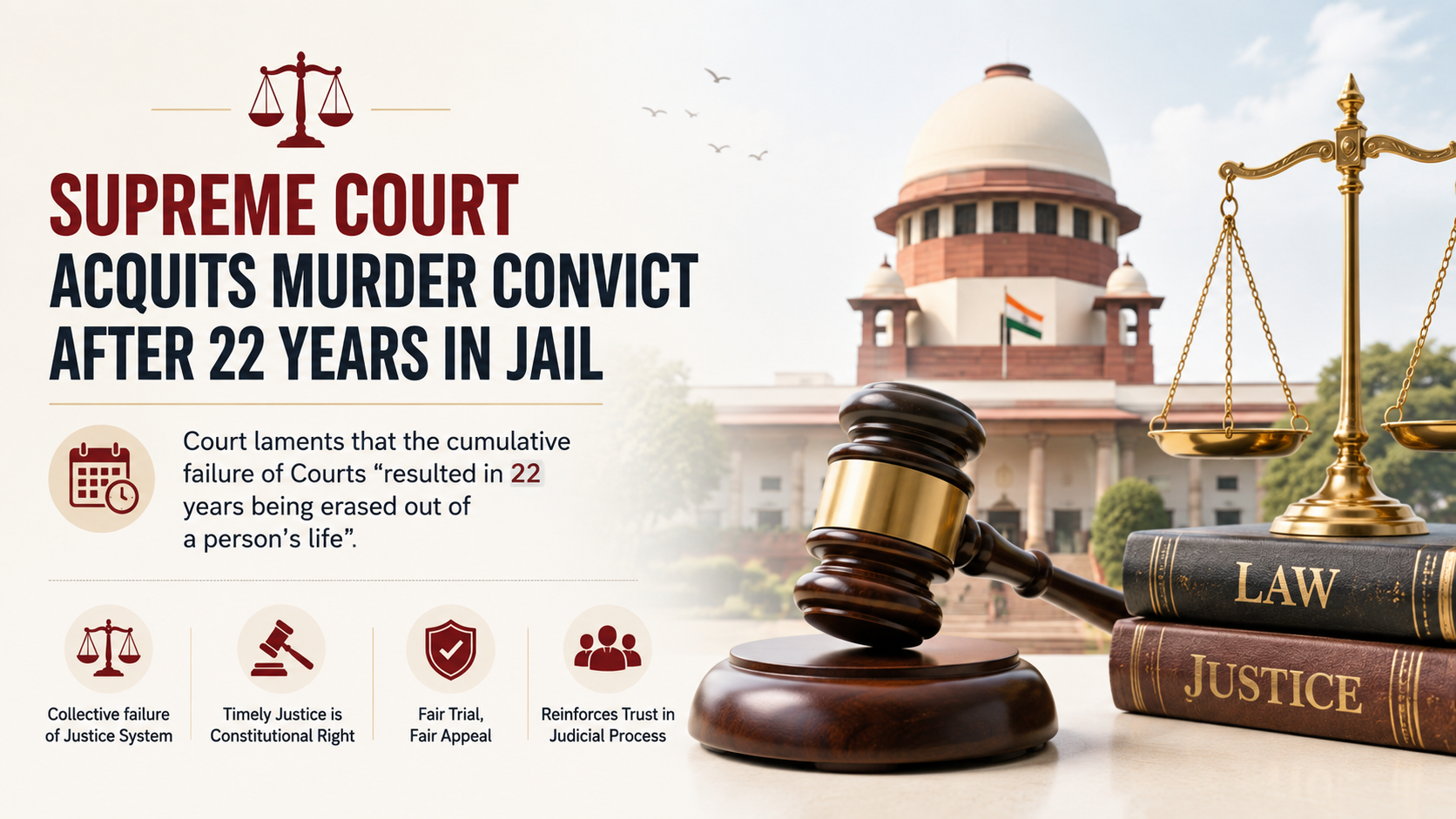
In a significant judgment underscoring the importance of timely justice, the Supreme Court acquitted a murder convict after he had spent 22 years in prison. The Court observed that the cumulative failure of multiple courts had effectively erased 22 years of a person's life, calling it a serious failure of the criminal justice system. (timesofindia.indiatimes.com)
Justice delayed has long been regarded as justice denied. In a recent judgment, the Supreme Court of India reinforced this principle by acquitting a murder convict who had remained behind bars for 22 years.
While setting aside the conviction, the Court expressed deep concern over the prolonged delay in the judicial process, observing that the combined failures at different stages of the justice system had deprived the individual of more than two decades of liberty. (timesofindia.indiatimes.com)
According to reports:
- ⚖️ The appellant had been convicted in a murder case and sentenced to life imprisonment.
- ⏳ He remained incarcerated for approximately 22 years.
- 📑 His appeal was ultimately examined by the Supreme Court.
- ✅ After reviewing the record, the Court acquitted him and criticized the systemic delays that prolonged the case. (timesofindia.indiatimes.com)
The Court remarked that:
The cumulative failure of the Courts resulted in 22 years being erased from a person's life. (timesofindia.indiatimes.com)The observation reflects the Court's concern that justice cannot be meaningful if legal errors and delays keep a person imprisoned for decades before their case is finally decided.
The ruling highlights several important principles:
✅ Timely Justice
Justice must be delivered within a reasonable time. Excessive delays can undermine the fairness and credibility of the judicial process.
✅ Right to Personal Liberty
Article 21 of the Constitution guarantees the right to life and personal liberty. Unnecessary or prolonged incarceration due to procedural failures directly impacts this constitutional protection.
✅ Duty of Appellate Courts
Appeals, especially in serious criminal cases, should be heard expeditiously. Delays can have irreversible consequences for the accused.
After a conviction by a trial court:
- 🏛️ The convicted person may appeal before the High Court.
- ⚖️ Further appeals or special leave petitions may be filed before the Supreme Court.
- 👨⚖️ Appellate courts examine whether the conviction is legally sustainable and supported by evidence.
A prolonged delay at any stage can significantly affect the administration of justice.
The Court's reference to a "collective failure" suggests that the delay was not attributable to a single institution but reflected shortcomings across different stages of the criminal justice process.
Possible contributing factors include:
- 📂 Delay in hearing criminal appeals.
- ⚖️ Procedural inefficiencies.
- 👨💼 Institutional backlog.
- 📑 Administrative delays.
- ⏳ Long-pending criminal cases.
The judgment draws attention to persistent challenges, including:
- ⚠️ Backlog of criminal appeals.
- ⚖️ Delay in final adjudication.
- 🏛️ Heavy workload on courts.
- 👨⚖️ Shortage of judges and judicial infrastructure.
- 📚 Need for faster disposal of long-pending cases.
The decision reiterates that:
- ✔️ Every accused is entitled to a fair appellate review.
- ✔️ Liberty should not be lost because of avoidable procedural delays.
- ✔️ Courts must prioritize long-pending criminal appeals.
- ✔️ Public confidence in the justice system depends on both fairness and timeliness.
- ✅ The Supreme Court acquitted a murder convict after 22 years of incarceration.
- ✅ The Court criticized the prolonged delay as a "collective failure" of the criminal justice system.
- ✅ The judgment emphasizes the constitutional importance of timely justice.
- ✅ The case highlights the need for reforms to reduce delays in criminal appeals. (timesofindia.indiatimes.com)
The Supreme Court's judgment serves as a reminder that the justice system must not only reach the correct outcome but also do so within a reasonable time. When appeals remain pending for years, the consequences can be life-altering. The Court's remarks underscore the urgent need to strengthen judicial infrastructure, reduce case backlogs, and ensure that justice is both fair and timely.
- LiveLaw – Supreme Court coverage of the acquittal and observations on systemic failure. (livelaw.in)
- The Times of India – Report on the Supreme Court acquitting a murder convict after 22 years and criticizing delays. (timesofindia.indiatimes.com)
- LiveLaw Supreme Court Digest – Discussion of the Court's observations on prolonged incarceration and delayed criminal appeals. (livelaw.in)