Legal Remedies for Allegations of Excessive Police Force During Protests
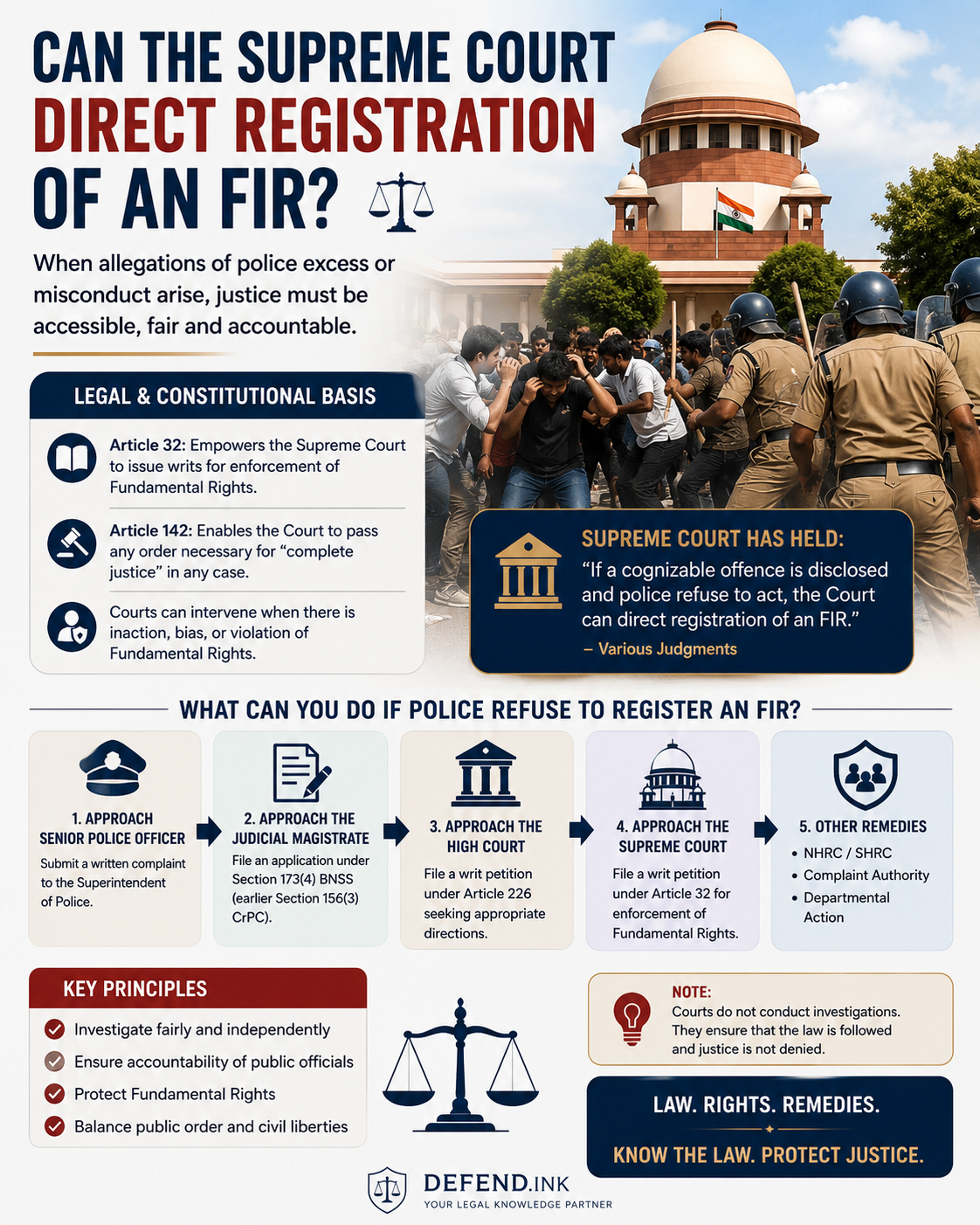
When allegations of excessive police force arise during a protest, it is crucial to understand the legal remedies available to the affected individuals. This post aims to clarify the legal framework surrounding such situations, focusing on judicial intervention and the registration of First Information Reports (FIRs).
Can Courts Direct the Registration of an FIR?
Yes, Indian courts have the authority to direct the registration of an FIR in cases where there is a reasonable suspicion of commission of a cognizable offense. The Supreme Court of India in Lalita Kumari v. Government of Uttar Pradesh (2014) clarified that the police are duty-bound to register an FIR when they receive information about a cognizable offense, as per Section 154 of the Criminal Procedure Code (CrPC).
When Can Judicial Intervention Be Sought?
Judicial intervention can be sought when there is a failure on the part of the police to register an FIR or when the investigation is not conducted in a fair and impartial manner. In Prakash Singh v. Union of India (2006), the Supreme Court emphasized the need for accountability in police actions and highlighted the importance of adhering to legal protocols during investigations.
Legal Framework and Protections
Conclusion
In summary, individuals alleging excessive police force during protests have legal avenues to seek justice. Courts can direct the registration of FIRs, and victims can approach the judiciary to ensure their rights are protected. Understanding these legal mechanisms is essential for addressing grievances effectively.